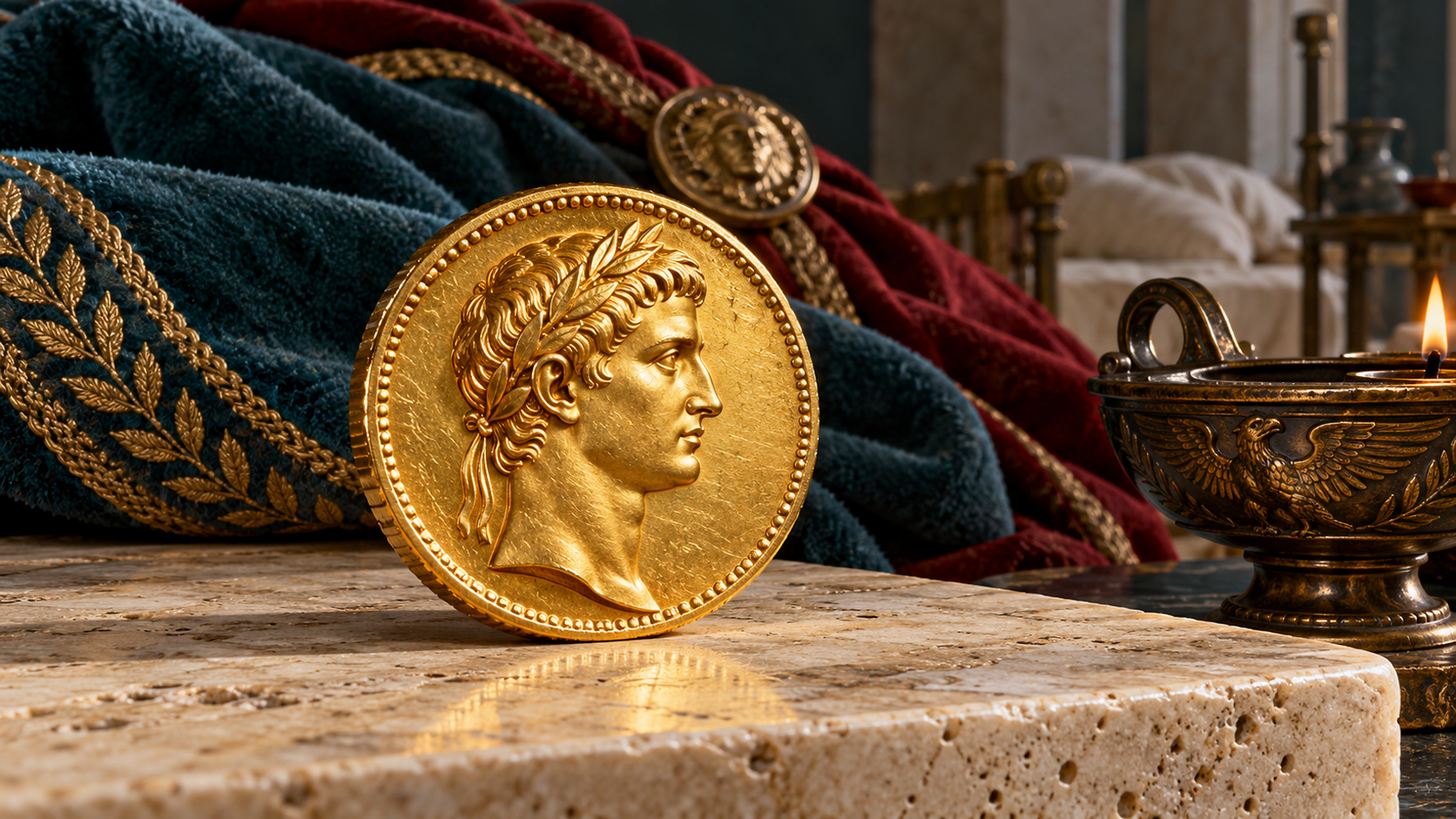
When Gaius Julius Caesar Octavianus died in August of AD 14, he was nearly seventy-six years old. He had survived decades of violent civil war, chronic stomach illnesses, political conspiracies, and the relentless wear of running an empire that stretched from the Atlantic coast of Iberia to the sands of Egypt. Yet if an ordinary baker in Rome, a legionary on the Rhine, or an olive farmer in southern Gaul pulled a fresh silver coin from their purse during the emperor's final years, the profile stamped into the metal looked untouched by time. The man on the coin still possessed high cheekbones, smooth skin, a calm brow, and the distinctive arrangement of hair that marked him out as a vigorous man in his early thirties. This was not an accident or a case of mint workers lacking skill. It was a deliberate, highly coordinated political branding campaign that lasted for decades.
The face of a seventy-five-year-old ruler
In the twilight of his life, Augustus was visibly frail. Roman historians such as Suetonius tell us that the elderly ruler wore four tunics, a heavy woollen cloak, and thick wrappings around his shins to keep out the winter chill. He suffered from dental decay, thinning hair, a limp from an injured hip, and dark liver spots across his torso. His body bore the undeniable marks of a man who had steered the Roman state through more than forty years of unprecedented political transformation. Yet the coins rolling out of the imperial mint at Lugdunum—modern Lyon in France—around AD 13 showed an athletic princeps with a jawline sharp enough to cut glass and skin as unblemished as polished marble.
To a modern observer accustomed to seeing leaders visibly grey and age in office under the unrelenting lens of news cameras, this refusal to show physical decline looks like simple vanity. In the ancient world, however, coin portraits operated under completely different rules. Beyond its use for trade and taxes, money served as the main mass communication network of the Mediterranean basin. Very few Roman subjects outside the capital ever travelled to Rome, and fewer still ever saw the princeps face to face. The image on a coin was their sole visual encounter with the supreme authority who guaranteed their security, settled their veterans, and kept the trade routes free from pirates.
By fixing his likeness in a state of calm maturity, Augustus sent a clear message about his regime. A visibly ageing leader suggested vulnerability, illness, and the terrifying prospect of another civil war over succession. An ageless face suggested that the peace Augustus had brought to Rome was equally permanent, immune to the rot of time, and protected by the gods.
The wrinkled portraits of the Roman Republic
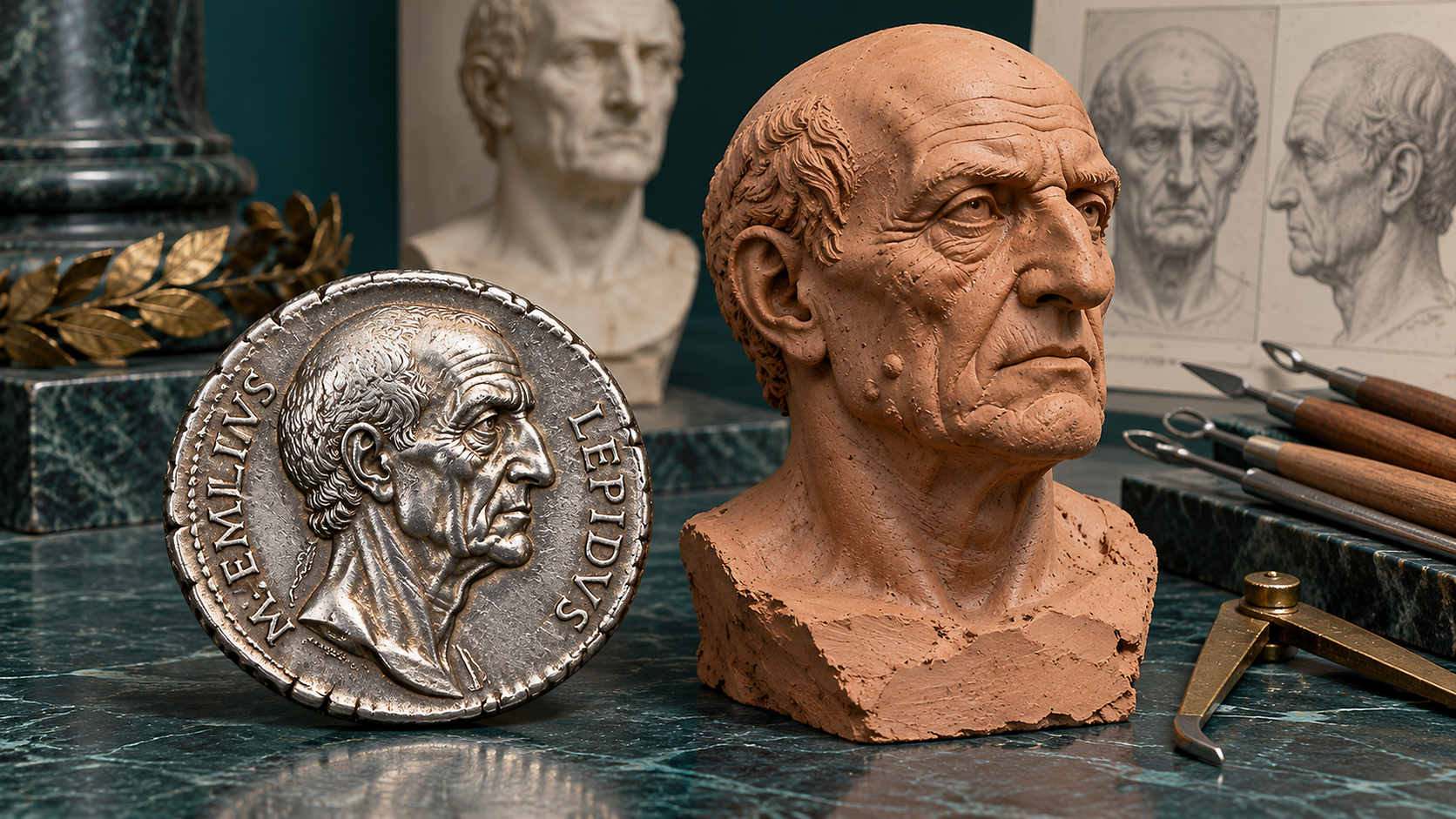
To grasp just how radical the ageless face of Augustus was, one must look at how Romans pictured their leaders before him. For centuries during the Roman Republic, the highest virtue a statesman could project was gravitas—a heavy, sober sense of duty, wisdom, and republican discipline. This cultural ideal gave rise to an artistic style known to historians as verism, from the Latin word verus, meaning true. Republican portraits did not try to make men look handsome or youthful. Quite the opposite: sculptors and engravers deliberately exaggerated every sign of advanced age.
A typical Republican magistrate portrait from the first century BC features sunken cheeks, sagging wattles below the chin, prominent crow’s feet around tired eyes, deep furrows across the forehead, and extensive baldness. Warts, crooked noses, and scars were displayed with immense pride. To Roman eyes, these physical defects were badges of honour. They proved that the individual had spent decades enduring the cold of military campaigns, the stress of senatorial debate, and the selfless burden of public office. A youthful face on a politician was viewed with deep suspicion; youth was associated with impetuousness, arrogance, and the kind of personal ambition that led to dictatorship.
When the Roman mint began striking coins with portraiture, this veristic tradition carried over directly into the metal. The moneyers who produced the Republic’s silver denarii celebrated their ancestors by portraying them as severe, elderly patriarchs who looked as though they had never cracked a smile in their entire lives. Age was equated directly with legitimate, constitutional authority. By deliberately walking away from this centuries-old tradition, Augustus was signalling that the old rules of Roman politics were dead.
Julius Caesar breaks the ultimate coin taboo
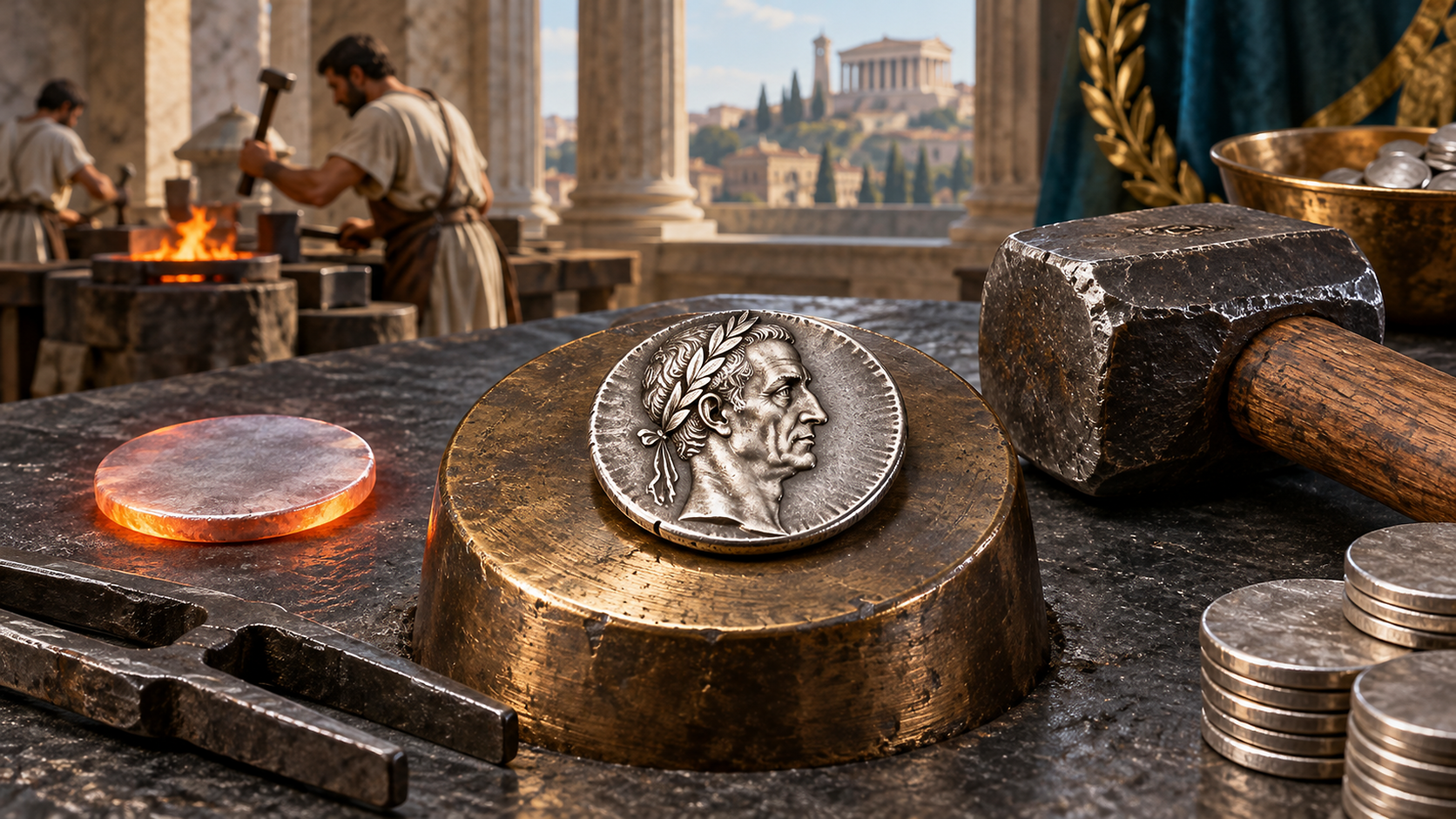
The path to the ageless imperial portrait was paved by Octavian’s adoptive father, Julius Caesar. Throughout the five centuries of the Republic, placing the face of a living human being on a Roman coin was an absolute taboo. Coins featured gods, goddesses, mythical founders like Romulus, or long-deceased heroes from ancient aristocratic families. Stamping your own living face on the state currency was something only Hellenistic kings in Egypt and Syria did, and Romans despised kings. Monarchy was the ultimate political sin in the Roman worldview.
In the early months of 44 BC, the Roman Senate granted Julius Caesar an unprecedented honour: his portrait could appear on the state's silver denarii while he was still alive. Engravers at the Rome mint quickly went to work, producing coins that showed Caesar as an ageing dictator with a craggy neck, prominent Adam's apple, and a receding hairline partially concealed by a laurel wreath. It was a veristic, realistic likeness, but its very presence on public money crossed a boundary from which Rome could never return. To many senators, seeing Caesar's wrinkled profile on daily pocket change was undeniable proof that the dictator saw himself as a monarch. Barely six weeks after the first portrait coins appeared, Caesar was assassinated on the Ides of March.
The assassination did not kill the new medium; it weaponised it. Caesar's murderers, Brutus and Cassius, soon struck coins featuring their own profiles to pay their armies, while Caesar's allies did the same. The taboo was shattered. From that moment on, civil war in Rome was fought not only with legions and warships, but with portrait dies hammered onto blanks of silver and gold.
Octavian's early look before the empire
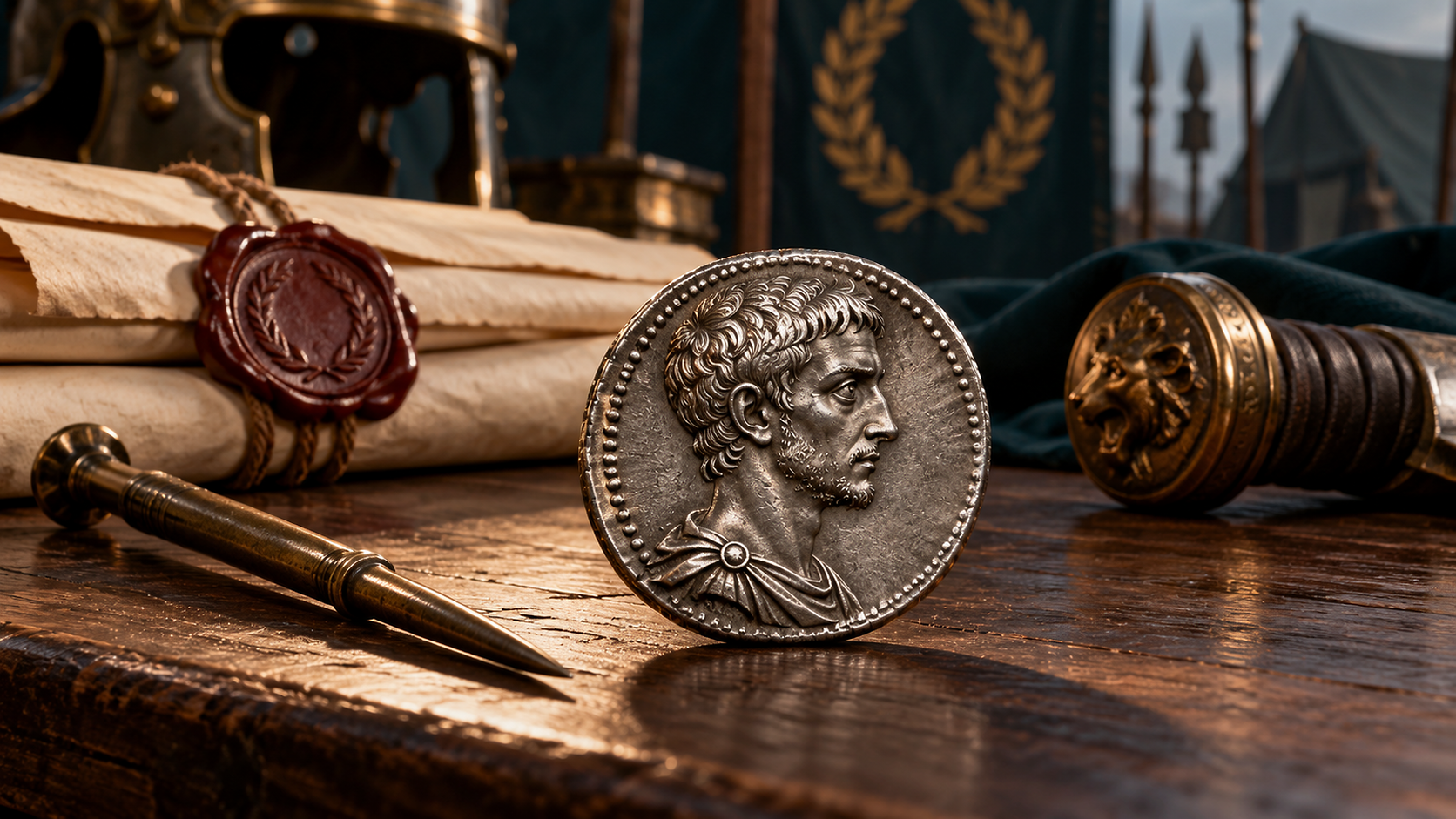
When nineteen-year-old Gaius Octavius learned that his great-uncle Caesar had adopted him in his will, he inherited Caesar's name, a loyal following among the legions, and an immediate death sentence from rival factions. The young man who arrived in Rome to claim his inheritance was not yet the serene emperor the world would come to know. He was a ruthless, embattled warlord, and his earliest coins reflect that raw, desperate struggle for survival.
On coins struck between 43 BC and 31 BC, during his uneasy alliance with Mark Antony and Marcus Lepidus in the Second Triumvirate, Octavian looks dramatically different from his later portraits. Engravers depicted him with sunken, hollow cheeks, an angular jaw, and thin, tense lips. In some issues, he is shown sporting a wispy, unkempt beard. In Roman society, letting one's beard grow was an ancient sign of mourning and vengeance; Octavian had publicly sworn never to shave until he had hunted down and killed every single one of Julius Caesar's murderers.
These early coins were not designed to project divine calm or classical beauty. They were designed to project vengeance, aggressive youth, and relentless determination. They spoke to soldiers who needed to know that their paymaster was dangerous, focused, and utterly devoted to avenging the martyred dictator. These portraits were fierce and human, bearing the tension of a young man fighting for his life in a blood-soaked political arena.
The turning point of Actium and the victory coins
In 31 BC, off the western coast of Greece, Octavian’s fleet under the command of Marcus Vipsanius Agrippa crushed the combined naval forces of Mark Antony and Cleopatra at the Battle of Actium. Antony and Cleopatra fled to Alexandria, where both committed suicide the following year. Octavian stood alone as the undisputed master of the Mediterranean world. Rome was finally at peace, but it was a peace born of total exhaustion. A century of recurring civil wars had decimated the senatorial aristocracy, ruined Italian agriculture, and left the population desperate for security.
Octavian faced an existential challenge: how could he maintain total military control over the state without appearing to be a tyrant like Caesar, who had been stabbed to death for overreaching? The solution lay in an elaborate, decades-long political performance. In 27 BC, in a staged theatrical event in the Senate, he ceremonially returned control of the state, its laws, and its provinces to the Senate and the Roman people. In gratitude for this apparent restoration of the Republic, the Senate voted him the honorary title Augustus, a sacred, reverent word meaning 'the revered one' or 'the exalted one'.
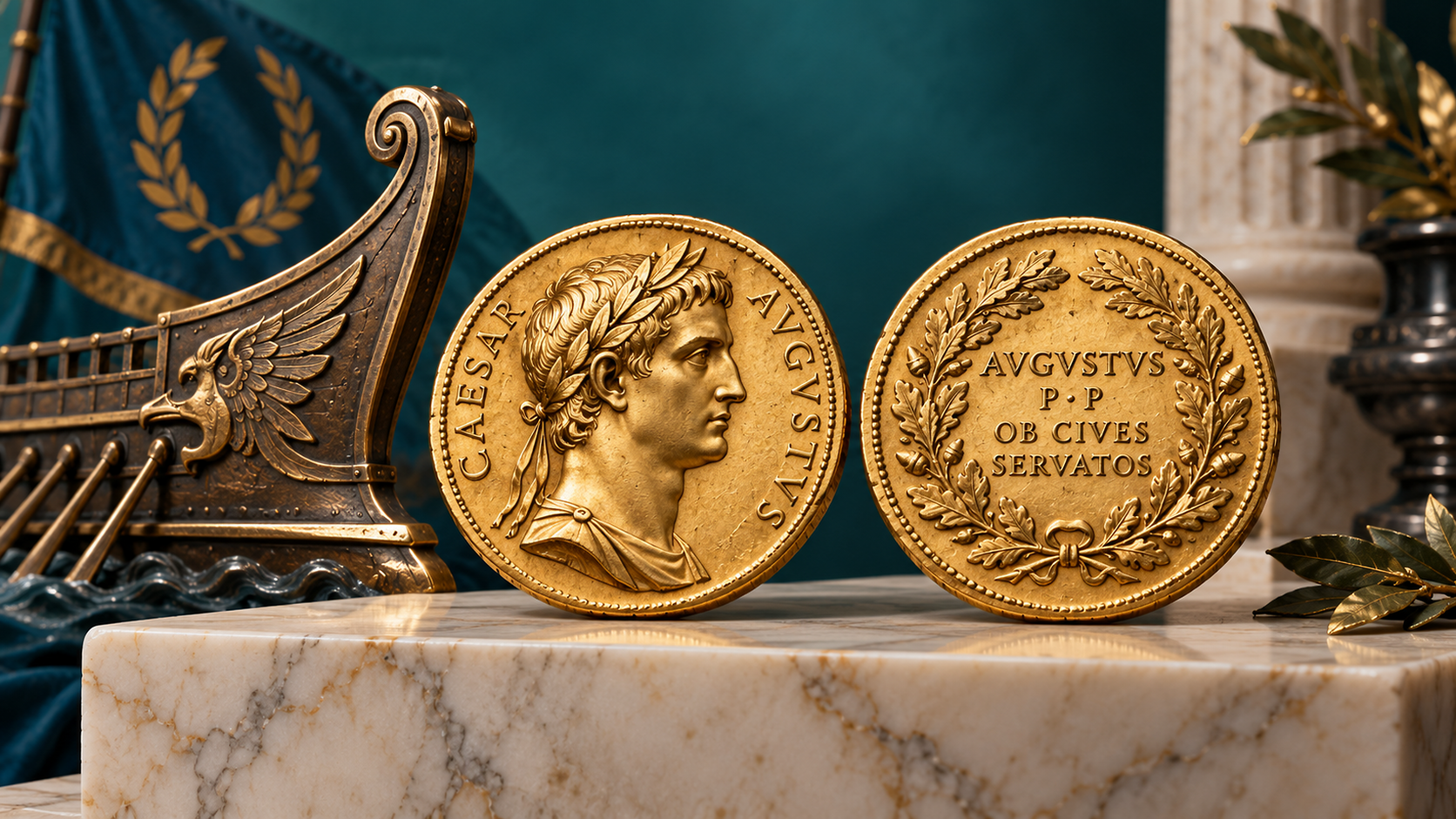
The rebranding of the ruler required an immediate, comprehensive overhaul of his visual identity. The tense, scowling warlord of the civil wars disappeared overnight from the mints. In his place appeared an entirely new human form: serene, majestic, and completely separated from ordinary mortality. The transformation was celebrated on gold aurei and silver denarii carrying the simple, powerful slogan Civibus Servatis—'For saving the citizens'—framed by an oak wreath awarded to him for ending the bloodshed.
Inventing an ageless face in bronze, silver, and gold
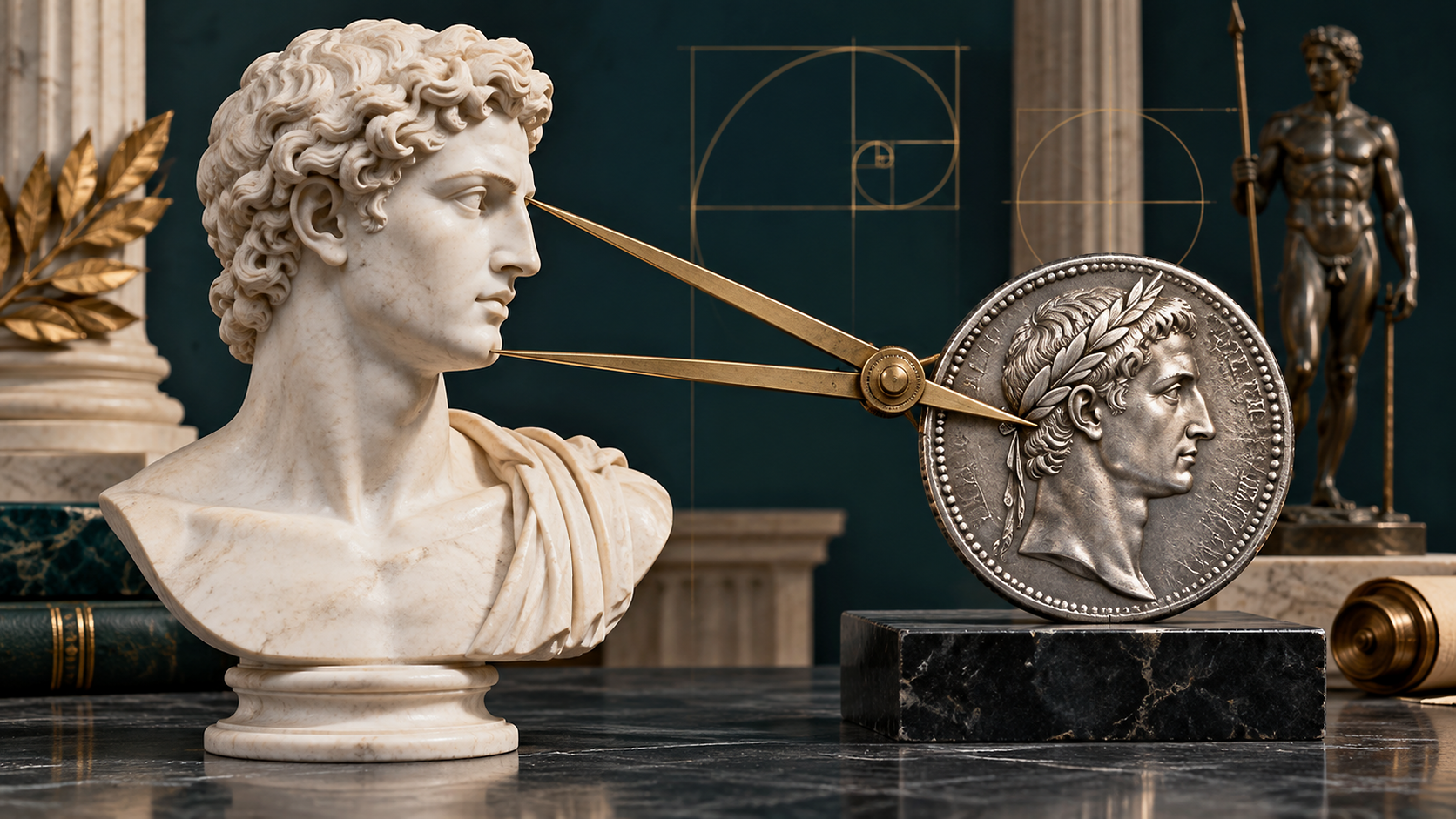
The official portrait created around 27 BC, often called by art historians the Prima Porta type after a famous marble statue discovered north of Rome, was a masterclass in visual propaganda. The artists who devised it rejected both the extreme, flawed realism of Republican verism and the theatrical, wind-whipped emotionalism of Hellenistic royal portraits. Instead, they reached back four centuries to the High Classical art of fifth-century BC Athens—specifically the athletic, mathematically balanced bronze statues of the Greek sculptor Polykleitos.
This new Augustan portrait struck a delicate visual compromise between recognizable reality and classical ideals.
It preserved enough of the real man's physical traits—the slightly hooked nose, the broad forehead, and the prominent ears—that everyone instantly recognised him. Yet every human imperfection was smoothed away. His brow became permanently calm, untroubled by worry or anger. His eyes were rendered wide and clear, staring straight ahead with majestic confidence. The lips were held in a relaxed, controlled expression that suggested perfect self-mastery.
Most crucially, the portrait was frozen at an ideal biological age: roughly thirty to thirty-five years old. This was the ancient prime of life, the precise age at which a Roman man was believed to possess the perfect balance of physical vigour and intellectual maturity. By adopting this classical, timeless template, Augustus separated himself from ordinary men who aged, weakened, and died. He transformed his image from a mortal politician into a living symbol of an enduring golden age.
The new design balanced recognizable features with classical perfection through three specific choices:
- Retaining his distinctive nose and ears so everyday Romans could identify him immediately.
- Eliminating forehead lines, crow’s feet, and sunken cheeks to project youthful health.
- Adopting the harmonious proportions of Classical Greek sculpture to evoke divine order.
The secret language of the Augustan hairdo
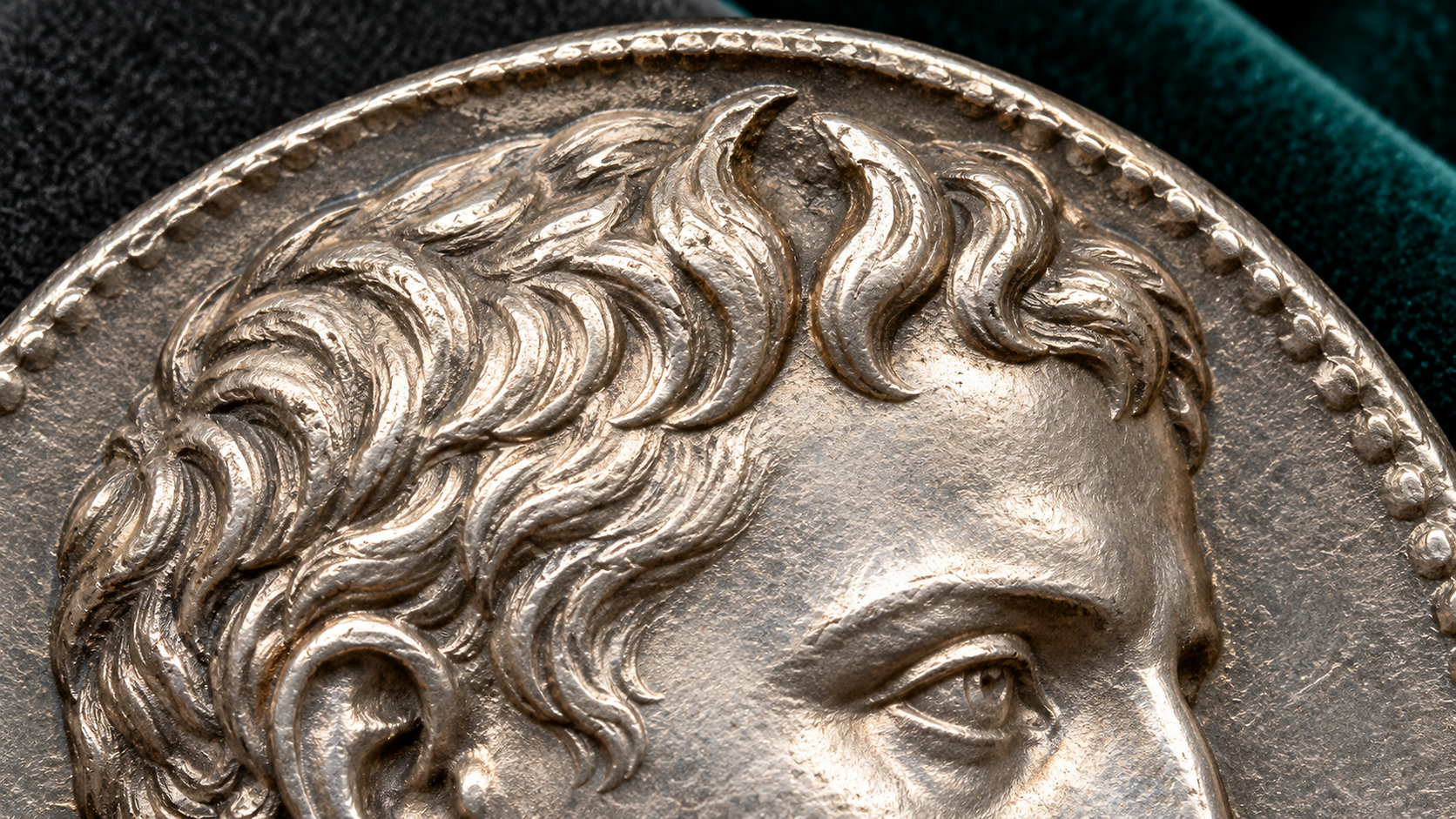
For modern coin collectors and archaeologists, the single most reliable way to identify an official portrait of Augustus is not his profile, but his hair. In the ancient world, where hairstyles were dictated by fashion, status, and religion, hair was a powerful communicative tool. Augustus's court sculptors and mint masters created a highly specific, standardised hairstyle that remained virtually unchanged on coins for over forty years.
The imperial hairstyle features thick, slightly wavy locks cut in a neat fringe across the forehead. At the centre of the brow, the hair parts in a very deliberate pattern: two locks separate to form an open claw-like pincers shape, while a third lock curls inward like a small comma. This arrangement, known in classical archaeology as the Zangenfrisur or pincer-and-fork motif, was not a casual morning style. It was an unmistakable artistic signature, as recognizable to a Roman soldier as a corporate logo is to consumers today.
This specific arrangement had deep symbolic roots. It closely mirrored the hair of ancient Greek statues of gods, particularly Apollo, the deity of light, order, and civilization with whom Augustus closely associated himself. It also evoked the heroic, windswept hair of Alexander the Great, the legendary Macedonian conqueror whose charisma Roman leaders constantly sought to emulate. Whenever a mint die was carved, whether by a master artisan in Rome or an apprentice in provincial Spain, getting this pattern of locks right was essential for certifying that the face on the coin was genuinely the princeps.
How mints across the Mediterranean copied the official likeness
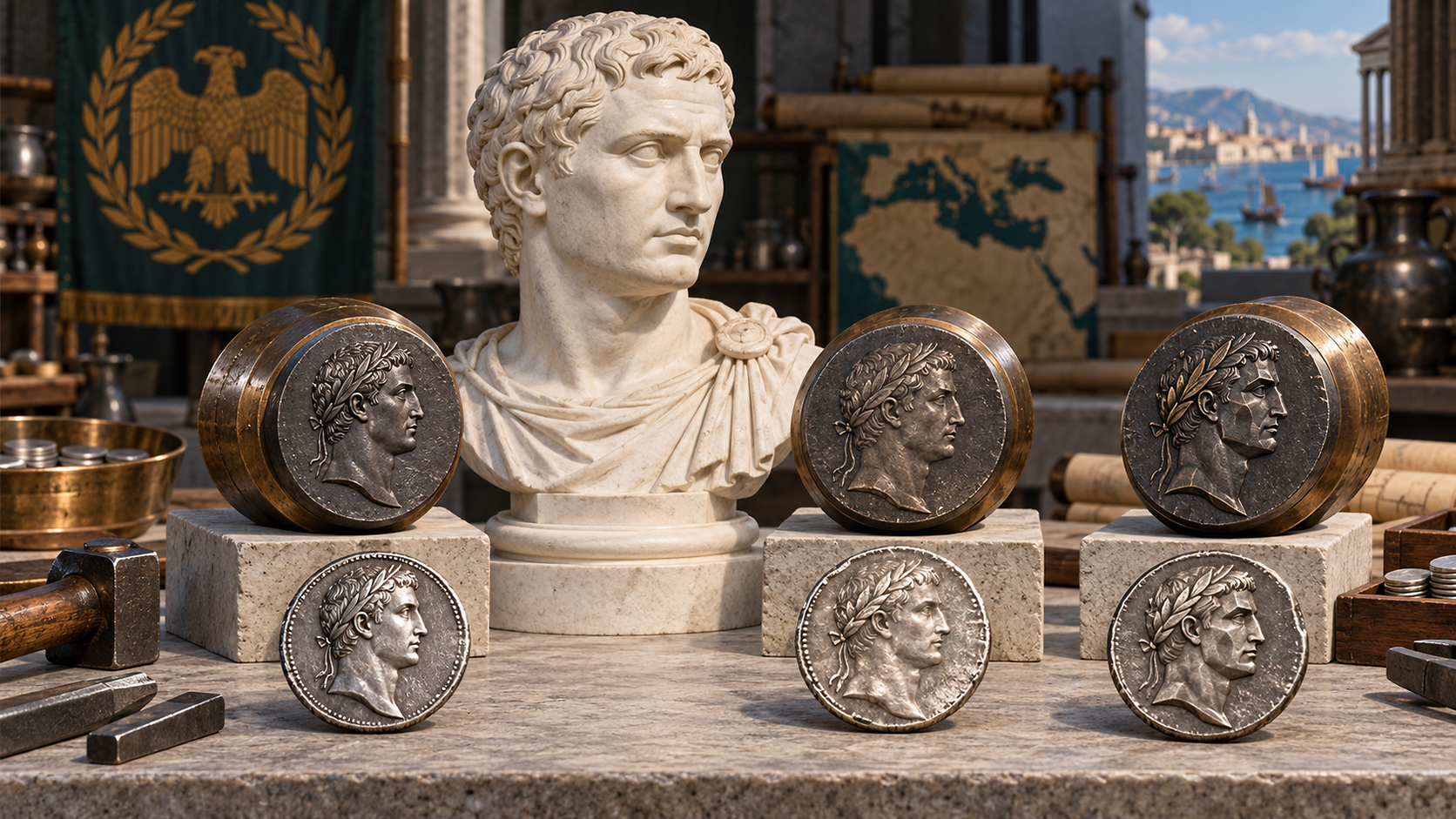
In an era before photography, the internet, or rapid mass transit, how did an empire spanning three continents coordinate a unified coin portrait? The process was remarkably systematic, relying on an empire-wide network of administrative hubs and master templates.
When a new official portrait type was approved in Rome, artists in the capital carved three-dimensional master models out of plaster, wax, or marble. These busts, known to scholars as portrait prototypes, were then dispatched by imperial messengers to major administrative centres and provincial capitals across the Mediterranean. From these master models, local die-engravers at regional mints created working dies. The die-cutters did not need to invent an artistic style; they simply had to carve a miniature mirror image of the bust directly into circular blocks of iron or hardened bronze.
The minting system ensured an astonishing degree of consistency, but regional variations still crept in. Coins struck at the primary imperial mints, such as Lugdunum in Gaul and the mint in Rome itself, adhered strictly to the pure classical standard with delicate, refined engraving.
In the eastern provinces, such as modern-day Turkey and Syria, Greek-trained die-cutters often made Augustus look softer, more divine, and slightly more regal, in line with centuries of Hellenistic royal coin traditions. In contrast, smaller western mints in Hispania sometimes produced cruder, more angular portraits with sharper lines and heavier chins. Yet across all these variations, the core identity remained ironclad: Augustus was always young, always composed, and always recognizable.
Engravers working from official portrait models achieved visual unity across several key regions:
- The primary imperial mint at Lugdunum produced the most balanced, elegant imperial types.
- Eastern Greek mints emphasized a softer, radiant look echoing Hellenistic kings.
- Western military outposts carved bolder, sharper profiles meant to look resolute to legionaries.
The message of timeless peace to a traumatised public
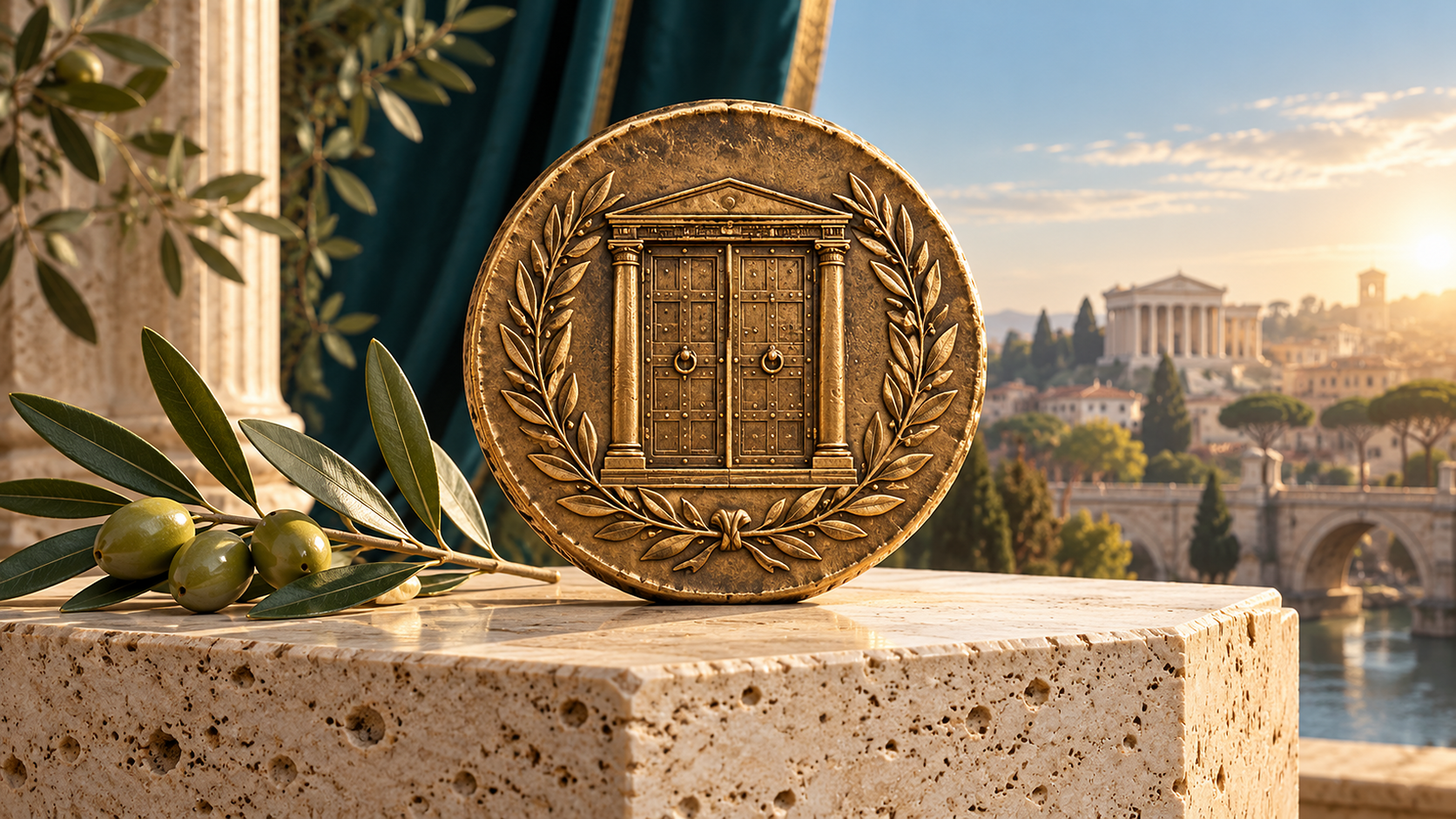
The decision to keep Augustus forever young addressed the psychological needs of an empire exhausted by civil war. The Roman public that welcomed Augustus was deeply scarred by decades of conflict. For over half a century, the Roman world had endured bloody proscriptions, confiscated farms, economic paralysis, and the terrifying spectacle of Roman legions slaughtering each other on Italian soil. Fathers had fought sons, and the social fabric of the Mediterranean had nearly collapsed.
Augustus marketed his rule around a single, intoxicating concept: the Pax Augusta, the Augustan Peace. Under his governance, the temple doors of Janus—shut only when Rome was completely at peace—were closed three times, an event that had occurred only twice before in the entire seven-hundred-year history of the city. He proclaimed the arrival of a new Golden Age, celebrated in the magnificent Ludi Saeculares (Centennial Games) of 17 BC, featuring poetry commissioned from Horace.
An ageing emperor was a terrifying prospect for people who believed that peace hung entirely on the life of one man. If Augustus showed signs of physical deterioration on his coins, it would remind everyone that his life was finite, reopening the dormant fear of another bloody civil war the moment he died. By presenting a face that never accumulated a single wrinkle, the imperial coinage communicated an unspoken, reassuring lie: the princeps would live forever, and the peace he brought would never fade.
Family dynastic marketing on silver denarii
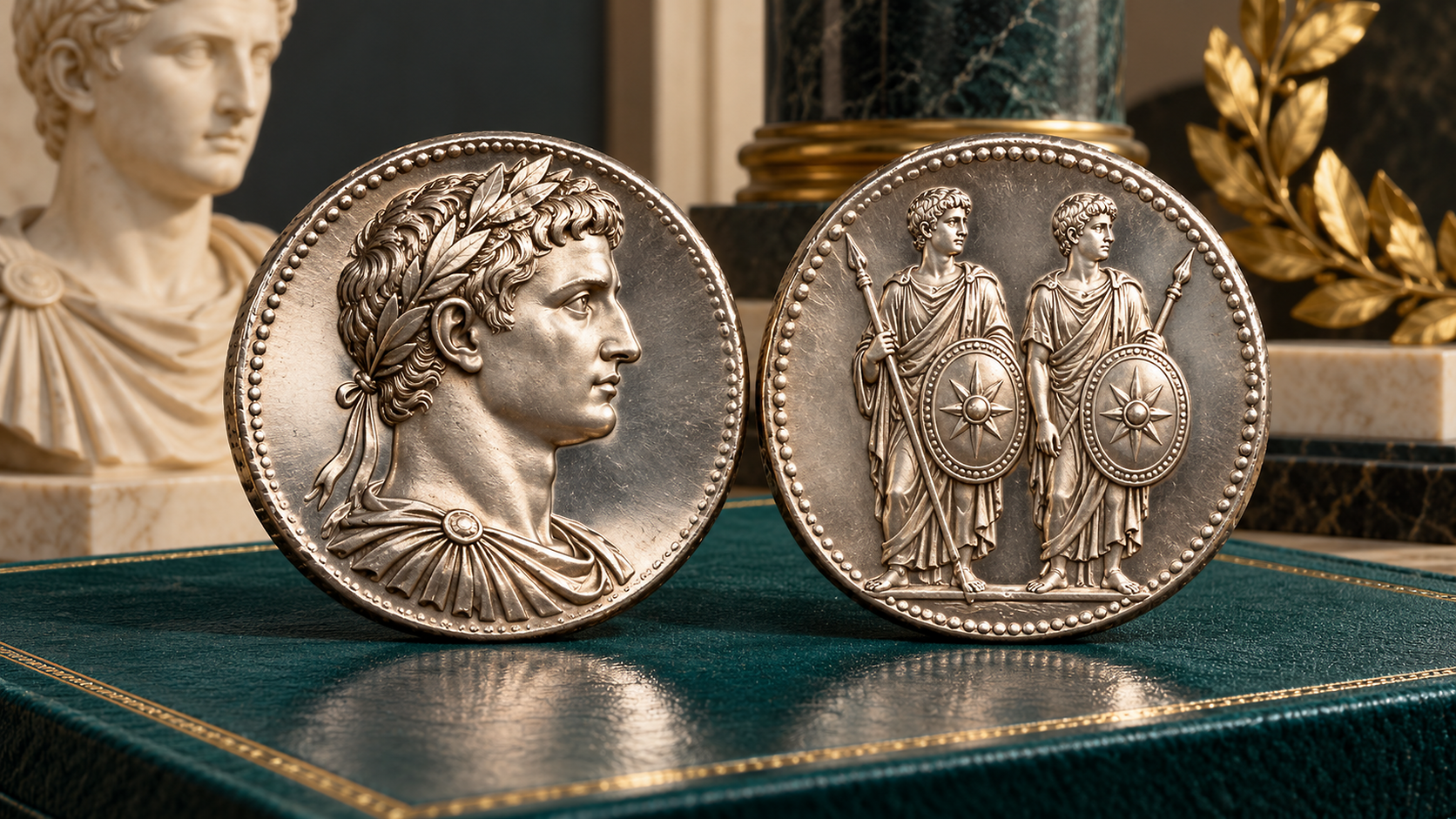
Because Augustus presented himself as permanently youthful, he faced a fascinating visual dilemma when it came to introducing his successors to the public. As the years passed, Augustus needed to prepare the Roman world for a peaceful transition of power. He had no surviving sons, so he turned to his grandsons, Gaius and Lucius Caesar, the children of his daughter Julia and his trusted general Agrippa.
Between 2 BC and AD 4, the mint at Lugdunum struck millions of silver denarii that are among the most famous coins from antiquity: the Gaius and Lucius type. The obverse showed the timeless head of Augustus, still looking thirty years old. The reverse featured the two young brothers standing side by side, wearing togas, their hands resting on ceremonial shields and spears presented to them by the equestrian order, with sacred priestly implements hovering between their heads.
The visual effect was striking and slightly bizarre: the grandfather on the front looked almost the same age as his adolescent grandsons on the back. The coin was not attempting to depict a realistic family tree. Instead, it was an explicit visual manifesto about the future of the empire. It told the Roman soldier and the merchant that the divine youth of Augustus was not an isolated miracle, but a hereditary family trait that would pass effortlessly to the next generation, ensuring eternal stability for generations to come. When both young men tragically died in their early twenties, shattering Augustus's succession plans, the coins remained in circulation as poignant reminders of how fragile even the most carefully crafted dynastic plans could be.
How the provinces adapted the Emperor's face
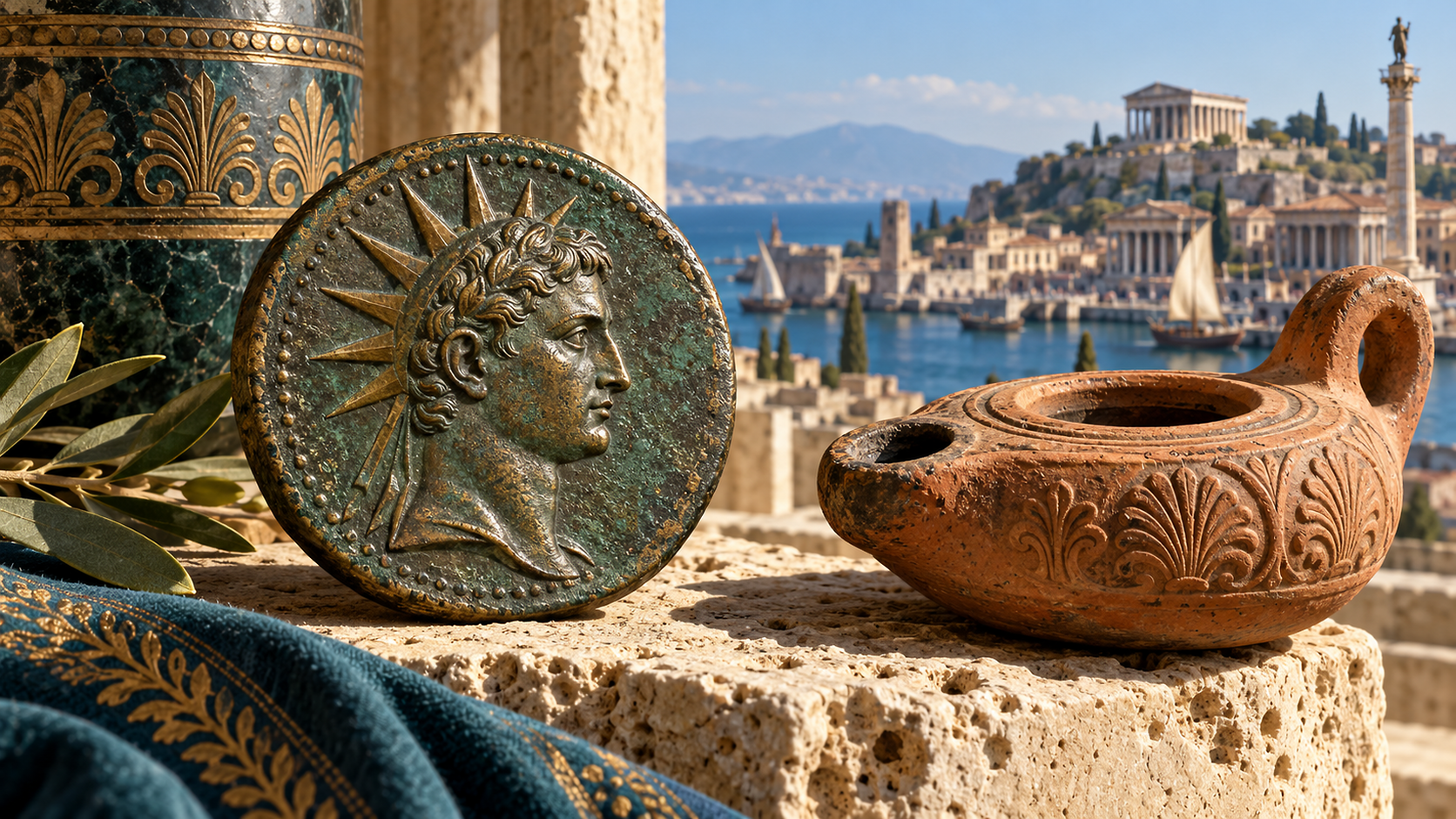
Beyond the central silver and gold coins struck under imperial supervision, hundreds of self-governing cities across the empire minted their own local bronze coins for daily trade. These provincial issues reveal how different cultures interpreted the ageless ruler. Augustus was cautious in Rome never to accept outright worship as a living god, which would have offended the senatorial class. But in the provinces, particularly the Greek East, ruler cults had been customary for centuries.
In cities like Ephesus, Pergamum, and Antioch, the ageless coin portrait was infused with explicit divinity. Provincial coin engravers frequently depicted Augustus with a radiant crown—its points mimicking the rays of the sun god Apollo—or set his bust alongside personifications of the Senate, the city itself, or local patron deities. While the central mints in the west preferred austere inscriptions like Augustus Divi Filius ('Augustus, Son of the Deified [Julius Caesar]'), eastern bronze coins openly called him Theos Sebastos—'God Augustus'.
In these provincial issues, the eternal youth of the emperor felt entirely natural to the local population. Gods did not age; Apollo, Hermes, and Dionysus did not develop wrinkles or receding hair. By maintaining an unblemished, youthful visage on his money, Augustus gave local populations an image that dovetailed seamlessly with their religious traditions. He was the protector of their cities, the bringer of good harvests, and the earthly incarnation of divine order.
What happened when the ageless ruler finally died
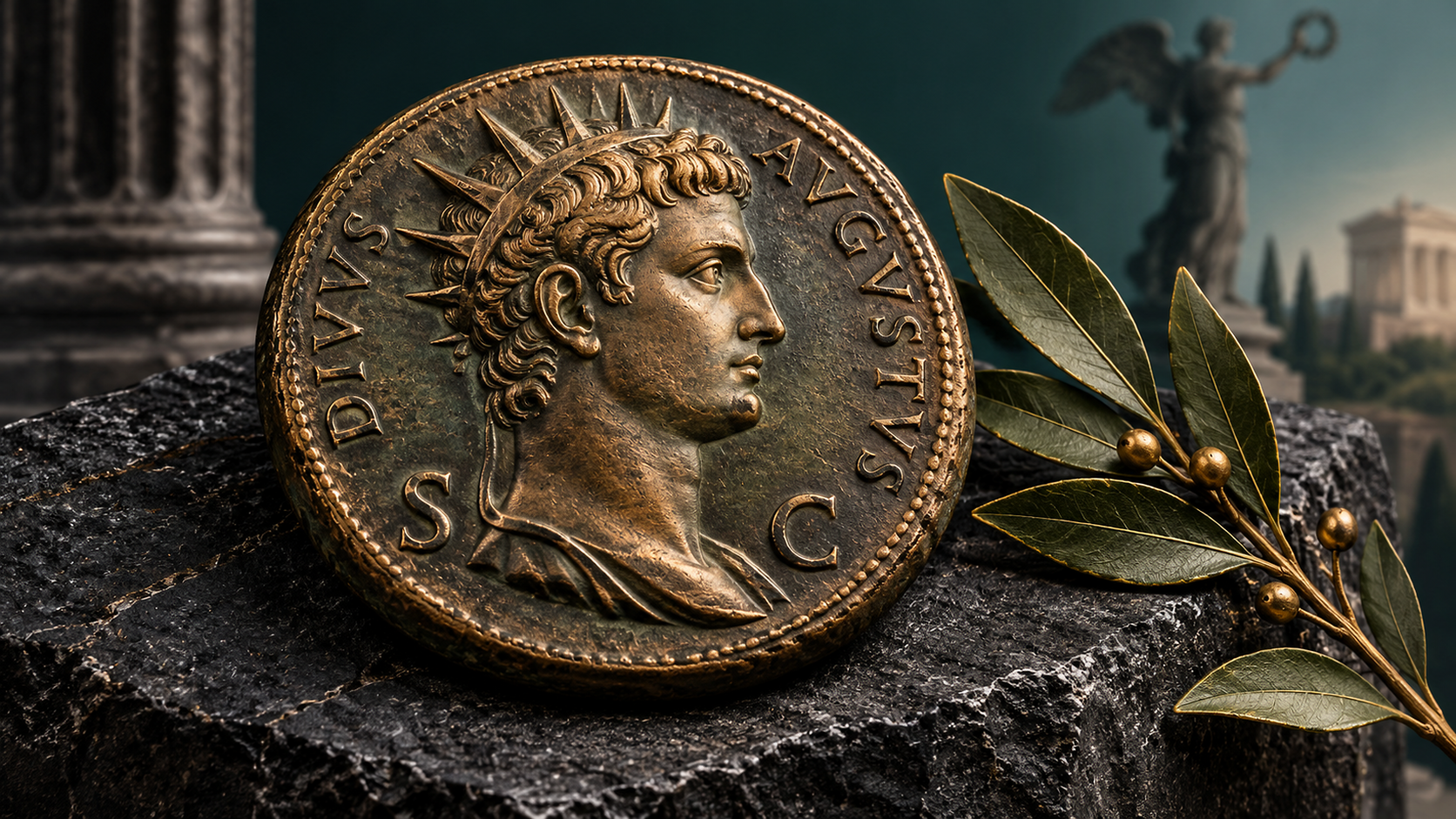
When Augustus finally passed away at Nola in August of AD 14, at the age of seventy-five, the Roman empire held its breath. The moment of vulnerability that the regime had spent four decades trying to conceal had arrived. Would the legions mutiny? Would the civil wars return? Thanks in large part to the relentless institutional and visual preparation Augustus had overseen, the transition of power to his stepson Tiberius occurred without the collapse of the imperial system.
Immediately following his death, the Senate officially deified Augustus. He was no longer just Divi Filius (son of a god); he was now Divus Augustus—the Divine Augustus. In a fascinating numismatic move, Tiberius did not erase his stepfather's image from the currency. Instead, Tiberius struck vast quantities of bronze and silver coins bearing the deified Augustus's portrait, now openly crowned with the radiant spikes of divinity or an oak wreath of salvation.
Crucially, on these posthumous coins, Augustus remained the same age he had been for the preceding forty years. Death had simply confirmed what the coins had claimed all along: the man was not subject to the ordinary rules of human decay. For decades afterward, subsequent emperors—including Caligula, Claudius, and Nero—regularly reissued coins featuring the ageless head of the empire's founder. Whenever an emperor's own political legitimacy was shaky, striking a coin with the timeless face of Augustus was the fastest way to remind the Roman people that the current regime was anchored in the golden peace of the first princeps.
The lasting legacy of Augustan image management
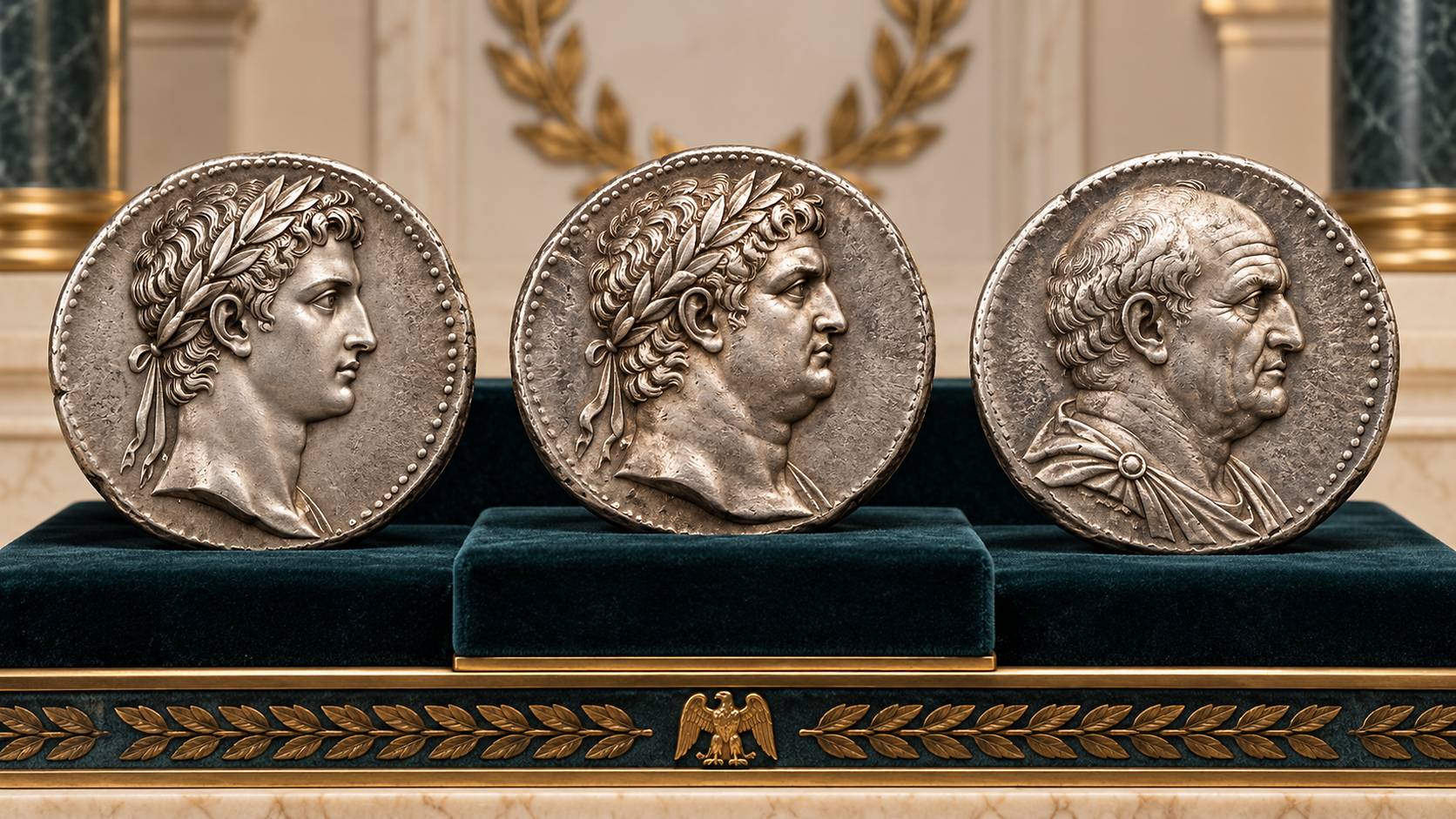
The decision to freeze the portrait of Augustus on Roman currency created a template that reverberated throughout the rest of Western history. Before Augustus, political portraiture in the West was either intensely realistic or mythical. Augustus merged the two, creating a third category: the idealised official portrait, where power, youth, and political policy were fused into an unshakeable visual brand.
Subsequent Roman emperors had to choose how to position themselves against this Augustan ideal. Some, like the flamboyant Nero, chose to show their real, changing faces, starting as slim boys and growing into heavy-jowled, thick-necked men on their coins. Others, like Vespasian after the chaotic civil wars of AD 69, deliberately returned to the rough, wrinkled, no-nonsense verism of the Republic to prove they were practical, hard-working soldiers rather than vain aristocrats. Yet the Augustan model—calm, classicised, and eternally capable—remained the gold standard to which rulers constantly returned.
Today, a two-thousand-year-old silver denarius of Augustus shows how carefully the Roman state managed royal imagery. That smooth, youthful face was designed to convince an anxious, war-weary world that the peace they enjoyed was permanent, that the state was secure, and that the ruler holding the reins of the Roman world was as enduring as the silver and gold that carried his name.
Further reading
Explore the subject further with these references.
The British Museum: Coins of the Roman Empire in the British Museum (BMCRE)External reference · Opens in a new tab Coinage and History of the Roman Empire (David L. Vagi)External reference · Opens in a new tab Roman Imperial Coinage (RIC), Volume I: From 31 BC to AD 69 (C.H.V. Sutherland)External reference · Opens in a new tab