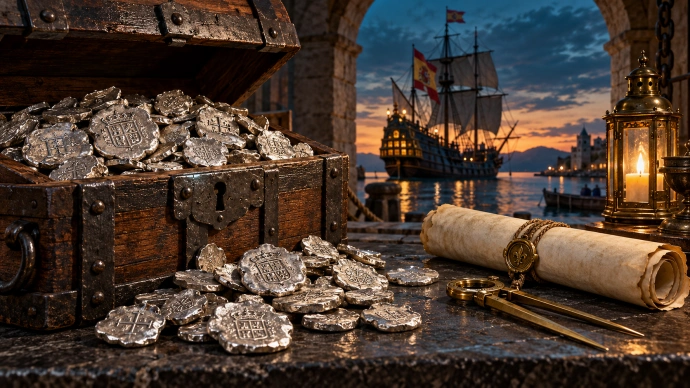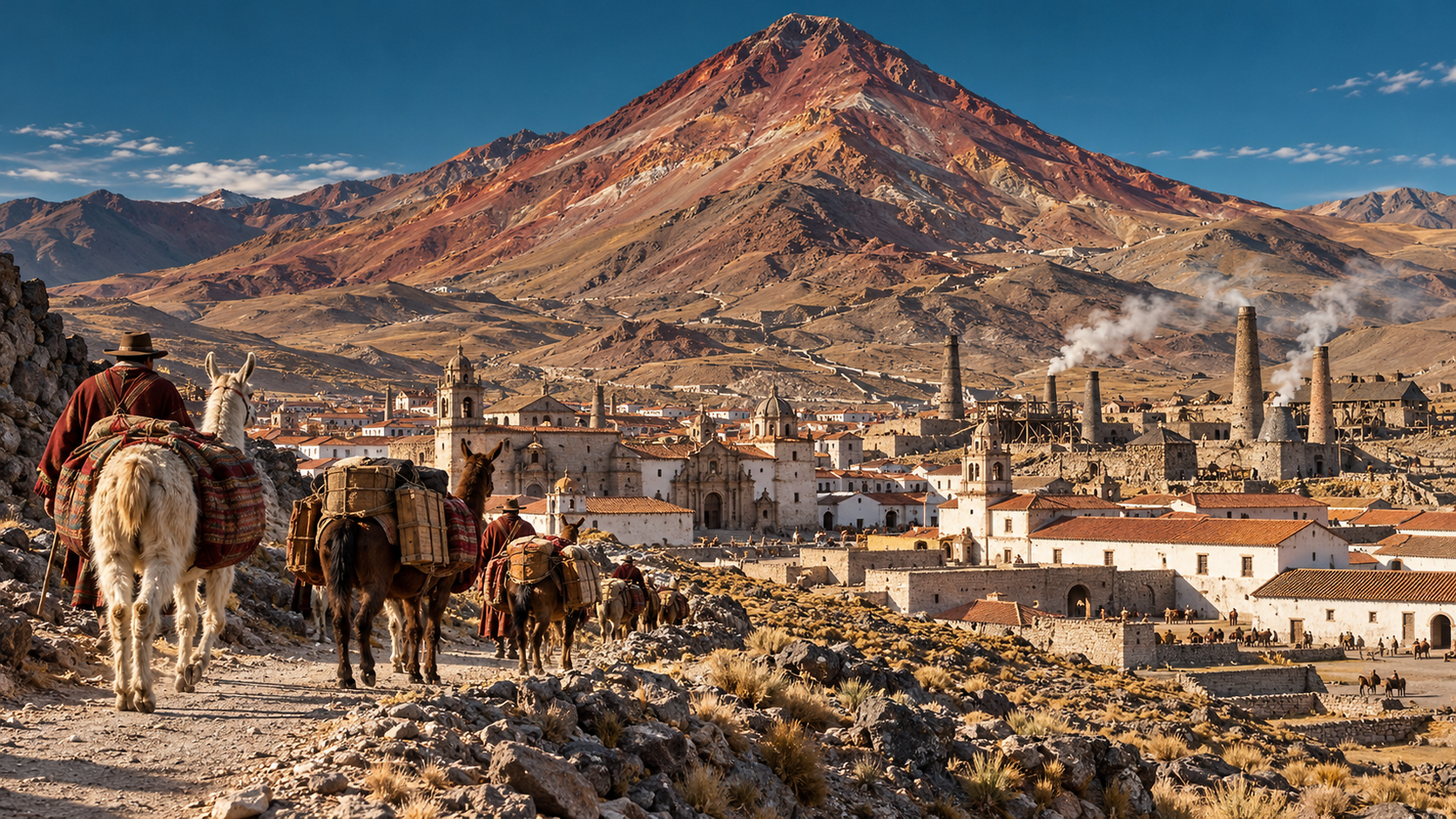
In the cold, thin air of the Bolivian Andes, more than four thousand meters above sea level, sits one of the most prolific industrial sites in human history. In 1545, Spanish prospectors realized that a red, conical mountain known as Cerro Rico was almost solid silver ore. Within a generation, the remote settlement of Potosí grew larger than Seville, London, or Rome. To turn that raw wealth into money the Spanish Empire could spend, officials could not wait months to haul crude bullion to the coast. They built an official mint directly beneath the summit, creating a high-altitude coin factory that would supply the world with silver for more than two centuries.
A boomtown above the clouds
The discovery of Cerro Rico, or the Rich Hill, transformed an empty Andean plateau into a roaring metropolis almost overnight. In 1545, an Indigenous worker named Diego de Gualpa reportedly revealed rich veins of silver ore on the mountain flank to a Spanish conqueror. What followed was a silver rush unlike anything Europe had ever witnessed. Despite freezing night winds, barren rocky soil, and an altitude where many newcomers suffered from acute sickness, fortune seekers poured in from across Spain, the Americas, and Europe.
By the early seventeenth century, Potosí held well over one hundred thousand residents. It had lavishly decorated stone churches, dozens of gambling halls, wealthy merchant estates, and thousands of workshops. The town was completely dependent on trade networks that stretched for thousands of miles. Food, timber, wine, clothing, and mining tools all had to be hauled up steep mountain passes on the backs of mules and llamas. Silver paid for every shipment, but trading unrefined metal was awkward and invited constant arguments over weight and purity.
To make tax collection predictable and simplify long-distance trade, the Spanish Crown required silver to be refined, taxed, assayed for purity, and cast into uniform currency before leaving the highlands. Transporting raw ore or unworked bars to Lima on the Pacific coast was dangerous and slow. The Crown needed an official mint right where the ore came out of the ground.
Why Spain built an Andean mint
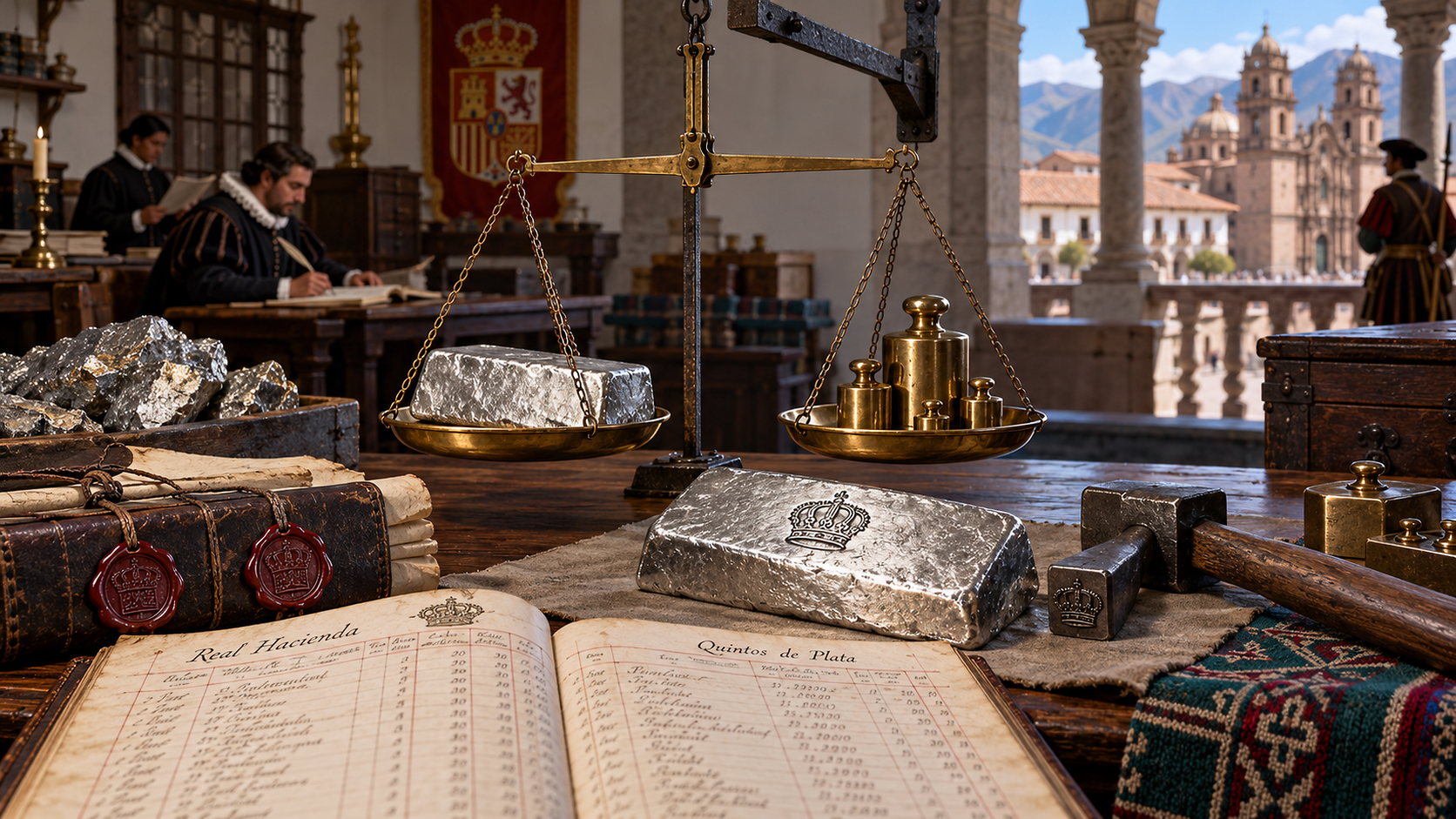
The Spanish Crown operated on a strict fiscal model. Any precious metal extracted from colonial soil was subject to the royal fifth, or quinto real, a twenty-percent tax owed directly to the monarch. When silver miners simply smelted their own bars and bartered with them in local markets, avoiding the tax was easy. Bars could be hollowed out, cut up, or mixed with cheap copper and lead.
In 1572, the energetic Spanish viceroy Francisco de Toledo arrived in Potosí to reorganize the entire silver economy. Toledo saw that the Crown was losing fortunes through tax evasion and informal exchange. His answer was structural reform: he centralized mining labor, overhauled the chemical processing of silver ore, and ordered the construction of the first Casa de la Moneda, or official mint, right in the center of Potosí.
The mint gave the Crown complete oversight over the supply chain. Miners were forced to bring their refined metal to the mint foundry. There, royal officials weighed the silver, deducted the king's taxes, tested the metal to guarantee standard purity, and stamped the remaining balance into legal-tender coins. Once the silver took the shape of an official coin, it was ready to enter the global bloodstream.
The human cost behind the metal
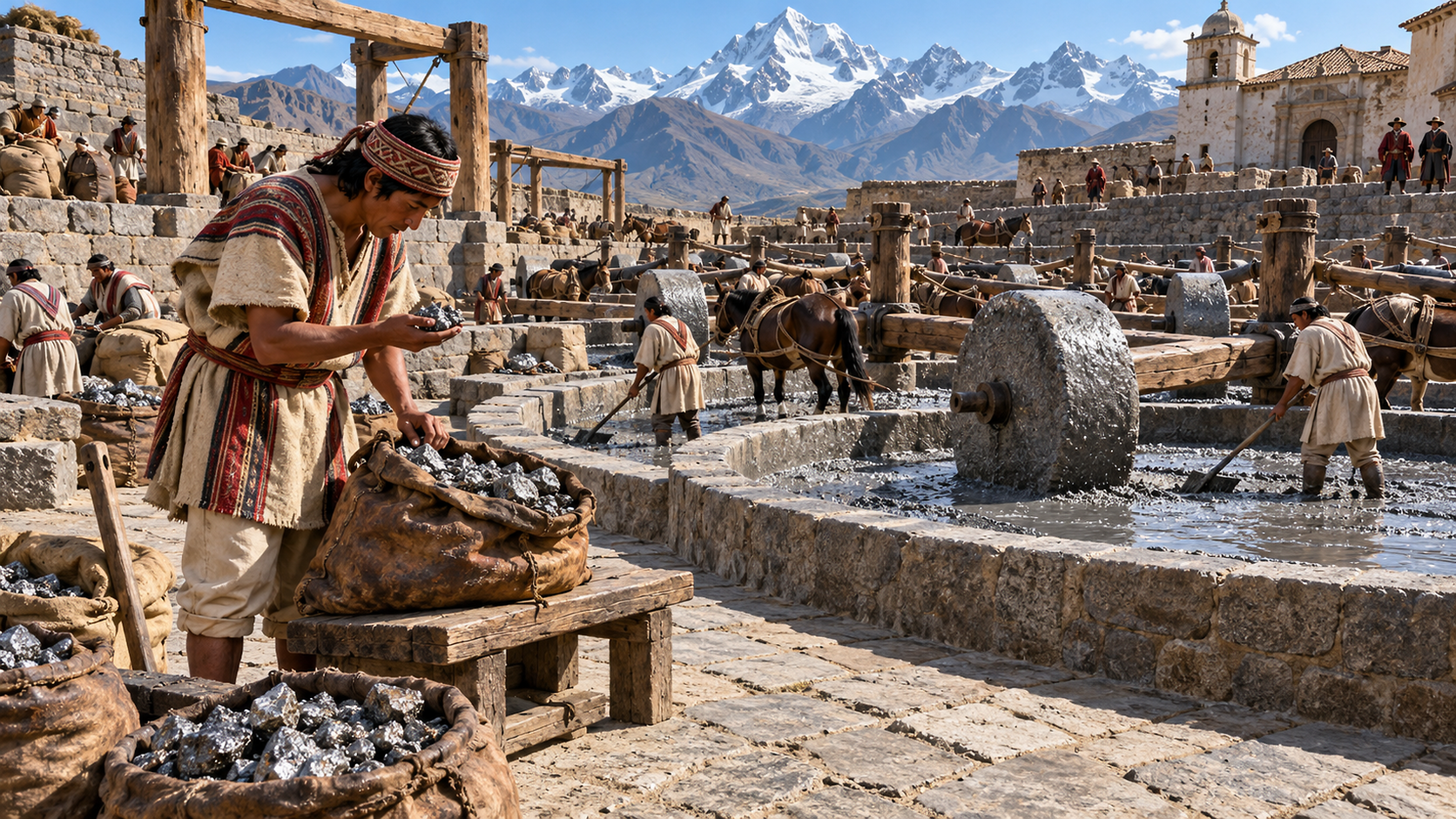
The silver that fed the Potosí mint did not appear by magic; it came from deep underground through an agonizing labor system. Viceroy Toledo revived and adapted an ancient Inca draft system known as the mita. Under this colonial law, Indigenous communities across hundreds of miles of the Andean highlands were compelled to send one-seventh of their adult men to work in Potosí for a full year.
Workers climbed deep into dark, unventilated tunnels on rope ladders, carrying heavy leather sacks of broken ore on their backs. The contrast between the stifling underground heat and the freezing alpine air above caused rampant respiratory sickness. In addition, processing the silver ore required the patio process, an industrial technique that used toxic mercury to bind and separate microscopic specks of silver from crushed rock. Indigenous laborers spent long days trampling slurry mixtures of rock dust, saltwater, copper sulfate, and liquid mercury with their bare feet.
Thousands of laborers died of mercury poisoning, rockfalls, and exhaustion. The wealth that stamped Potosí silver coins with royal shields came at an immense human toll, acknowledged even by contemporary chroniclers who called the mountain the 'eater of men.'
Smelting and cutting the first blanks
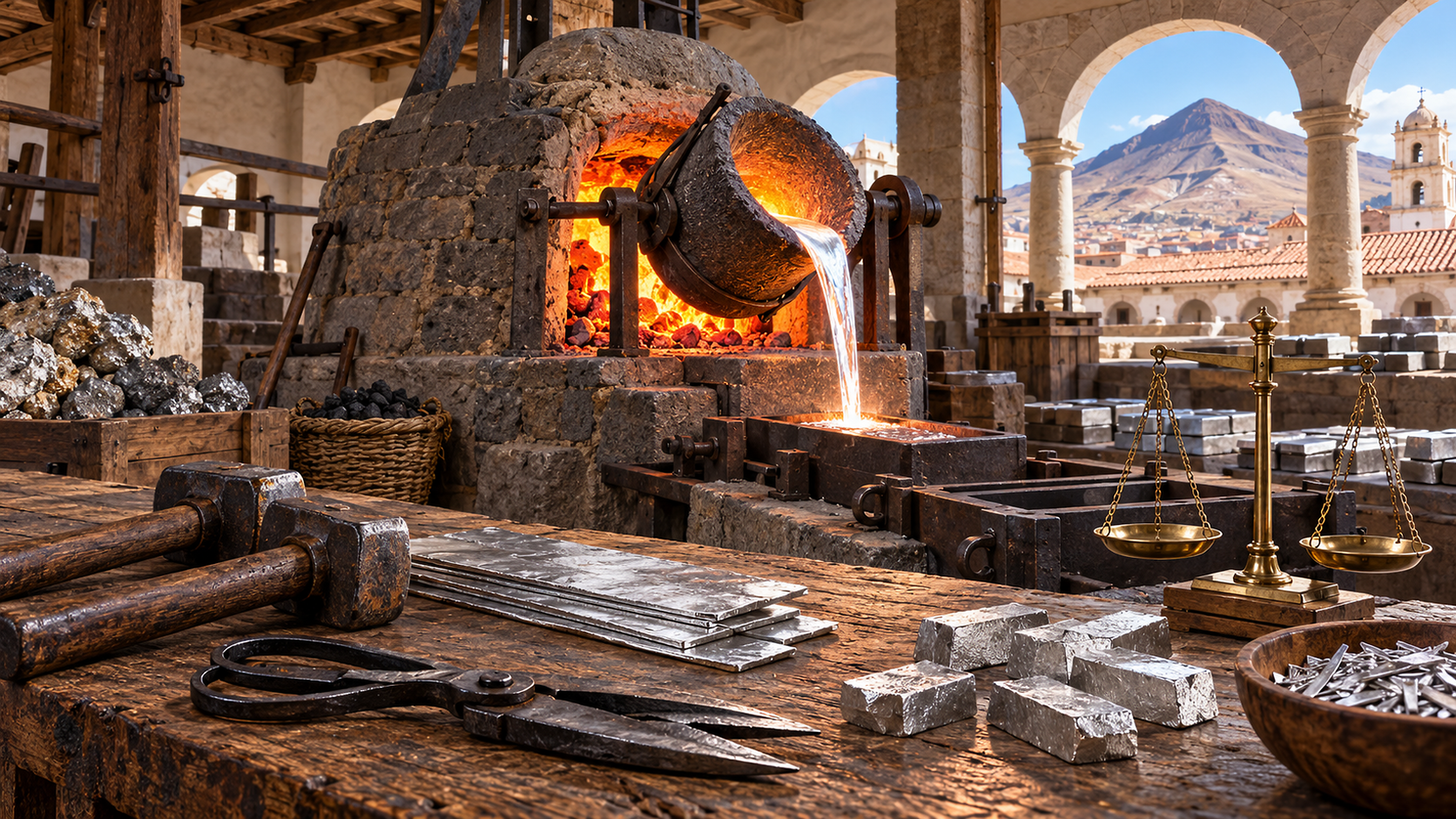
Inside the original mint building, the production process began in the foundry. Refined silver arrived as crude ingots or porous spongy masses left behind after mercury had been burned off in kilns. Foundry workers melted the metal down in large clay and iron crucibles heated by burning wood and charcoal brought from distant valleys.
Once the silver was completely molten, metallurgists stirred in just enough copper to bring the alloy to the official legal standard: roughly 93 percent pure silver, known historically as eleven dineros and four grains of fineness. The molten alloy was then poured into long, narrow molds to form thick bars.
Workers flattened these silver bars by hand using heavy iron sledgehammers. Blacksmiths hammered the bars into long, rough strips until they reached the approximate thickness of a coin. From these strips, cutters used heavy hand shears to snip off angular, chunky metal pieces. Each metal blank was individually weighed on balanced scales. If a piece was too heavy, the worker clipped a small sliver off the corner. If it was too light, it went back into the crucible to be melted down again.
The crude craft of the cob
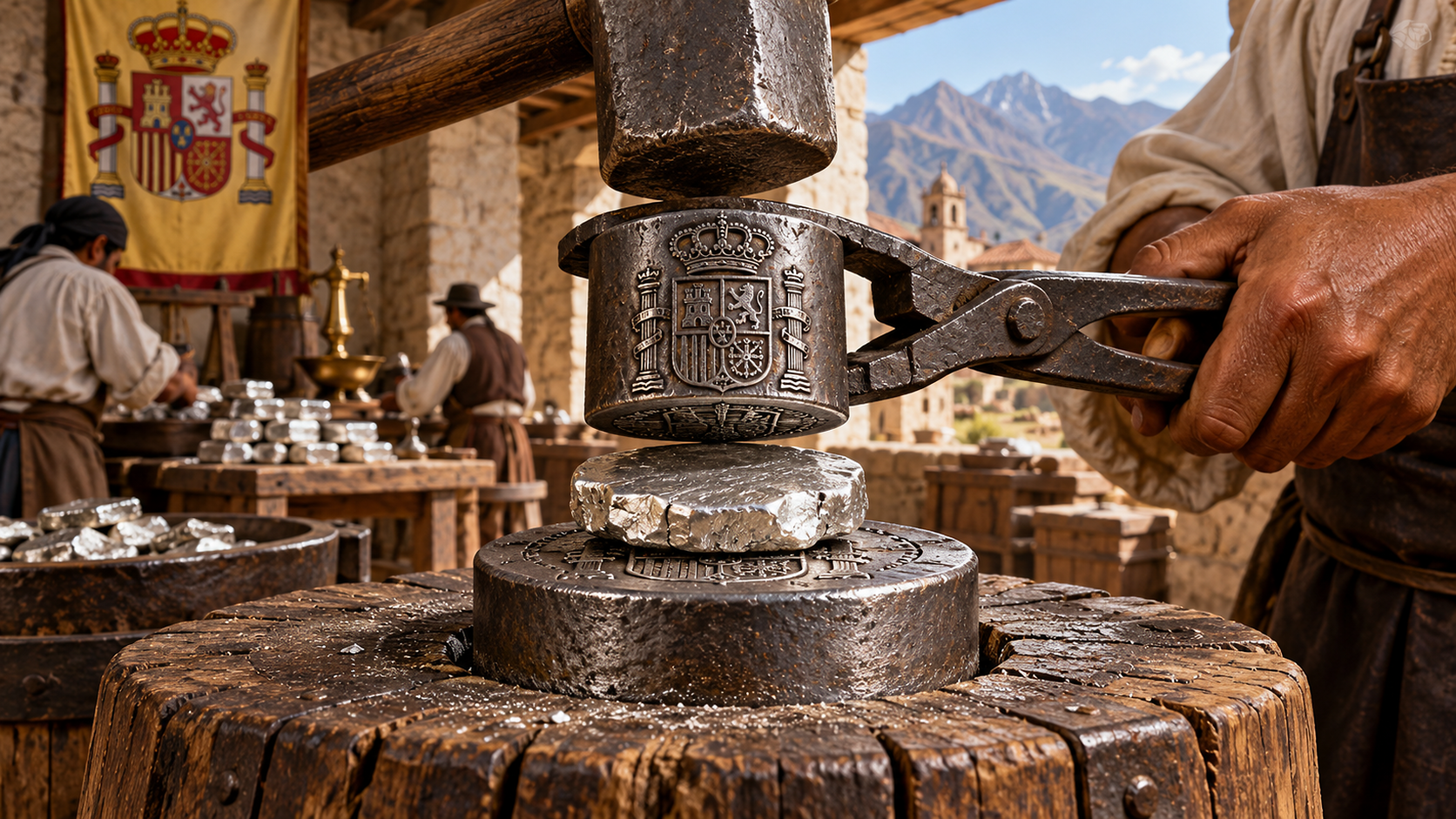
Before mechanized presses arrived in the mid-eighteenth century, coins produced at Potosí looked nothing like the flat, perfectly round discs we carry today. Collectors and historians call these early hand-hammered pieces cobs, an English term likely derived from the phrase 'clump of bullion.' In the Spanish-speaking world, they were known as macuquinas, a word borrowed from Quechua meaning rough or cut metal.
To make a cob, a worker rested a cold or slightly warmed blank on an anvil that held the lower die, which carried the design of the Spanish royal coat of arms. A second worker held the upper die, which carried the design of the cross with lions and castles, steady with iron tongs. A third worker struck the top die with a heavy mallet.
Because the metal blanks were thick, uneven, and irregular, a single hammer blow rarely transferred the entire design. The edges of the blank often split under the force of the strike. Most Potosí cobs emerged with parts of the inscription missing, flat spots where the die failed to bite, and sharp, jagged corners. As long as the coin met the exact legal weight and displayed the mintmark, assayer mark, and denomination, merchants and tax collectors accepted it as full payment.
Deciphering the marks on a coin
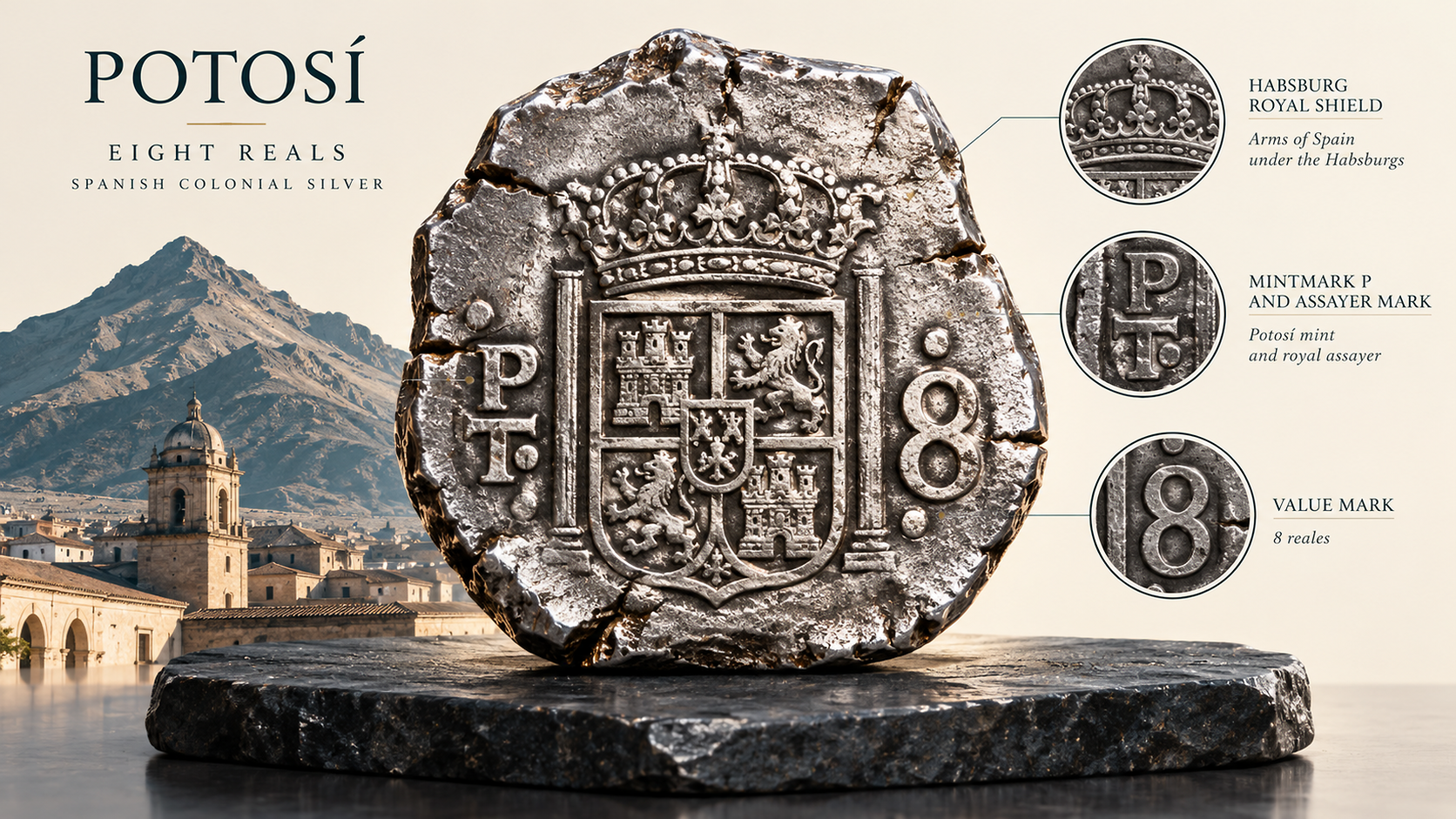
To make sense of a crude Potosí cob, one must know where to look. Even on an oddly shaped piece of metal, Spanish regulations required specific pieces of information to appear on every strike. Every eight-real coin—the famous real de a ocho—was designed to tell the story of who made it and when.
The face of the coin carried the crowned shield of the ruling monarch, surrounded by the royal titles. Next to the shield sat two vital markings: the mintmark and the assayer's initial. At Potosí, the earliest coins were stamped with a simple capital letter P. On the opposite side of the shield, a Roman or Arabic numeral indicated the denomination, such as an 8 for an eight-real piece, a 4 for a four-real coin, down to half-real coins.
The reverse displayed the Jerusalem cross, decorated with castles and lions in its four quadrants, representing the kingdoms of Castile and León. When reading an early cob, finding a complete date is often difficult because the dates were stamped along the outer rim where the metal often fell away. Numismatists look closely at the assayer mark—the personal initial of the mint official responsible for testing the metal—to narrow down the exact period when an undated coin was struck.
The great debasement scandal
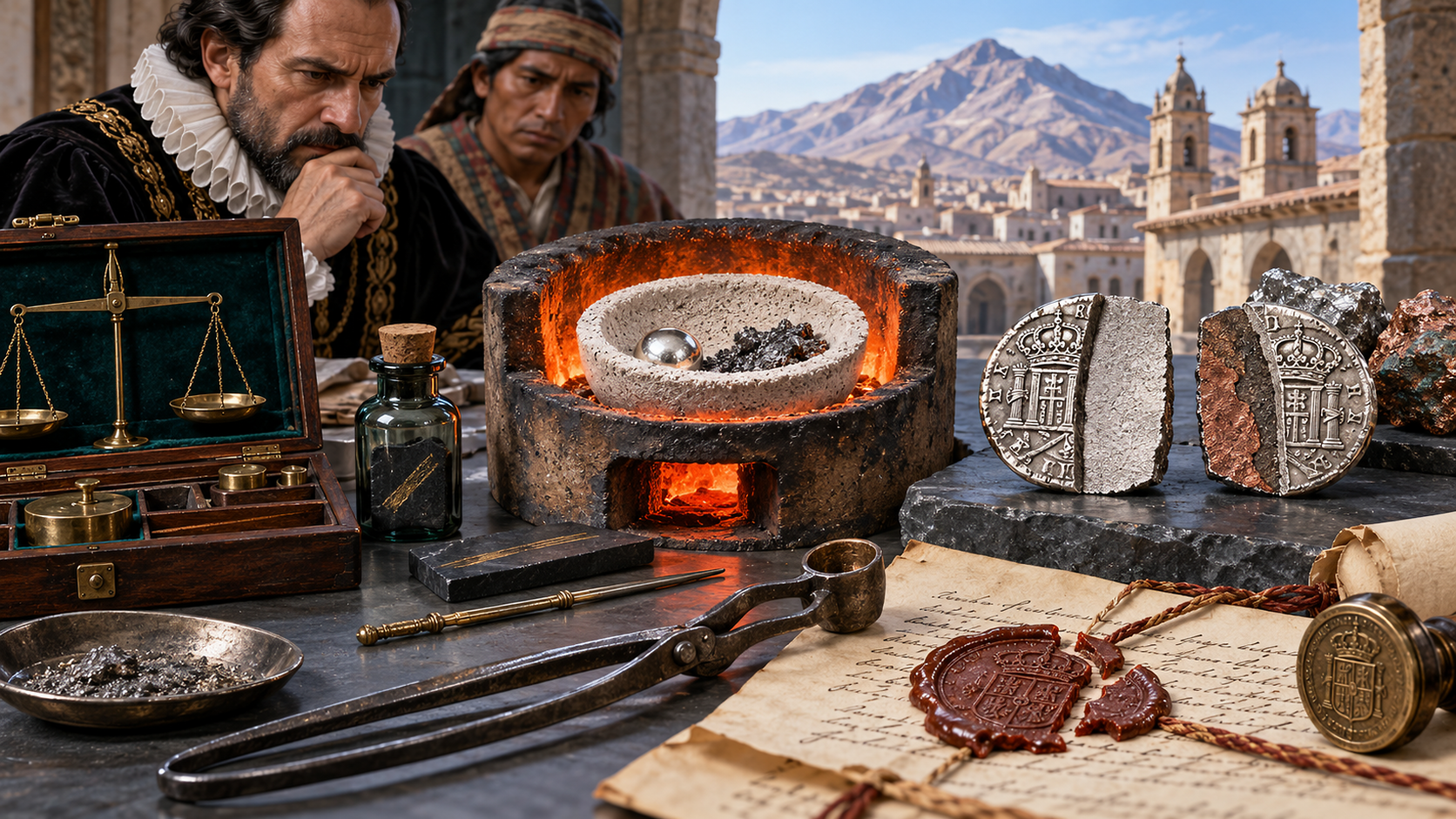
Because cobs had irregular edges and patchy designs, they were easy targets for fraud. More dangerous than street-corner clipping, however, was corruption inside the mint walls. In the 1630s and 1640s, Potosí became the center of the largest financial crime in the early modern world.
A network of high-ranking mint officials, wealthy mine owners, and corrupt assayers conspired to systematically dilute the silver alloy. They pocketed vast sums of royal silver and replaced it with cheap copper, producing millions of coins that fell far below the mandatory 93 percent purity standard. Some batches contained less than 75 percent silver. The tainted coins flooded international trade routes, reaching merchants in Amsterdam, Genoa, Istanbul, and Beijing.
When European bankers tested shipments of Potosí silver and discovered the fraud, confidence collapsed. Merchants refused to take Peruvian coins except at a steep discount, threatening to freeze Spanish royal credit. In response, King Philip IV sent an inquisitor and special investigator, Francisco de Nestares Marín, to Potosí with absolute authority to clean up the mint. Nestares Marín carried out ruthless investigations: the chief assayer and several conspirators were publicly hanged, corrupt officials were stripped of their wealth, and the Crown ordered all debased coins recalled and reminted.
Restoring faith with pillars and waves
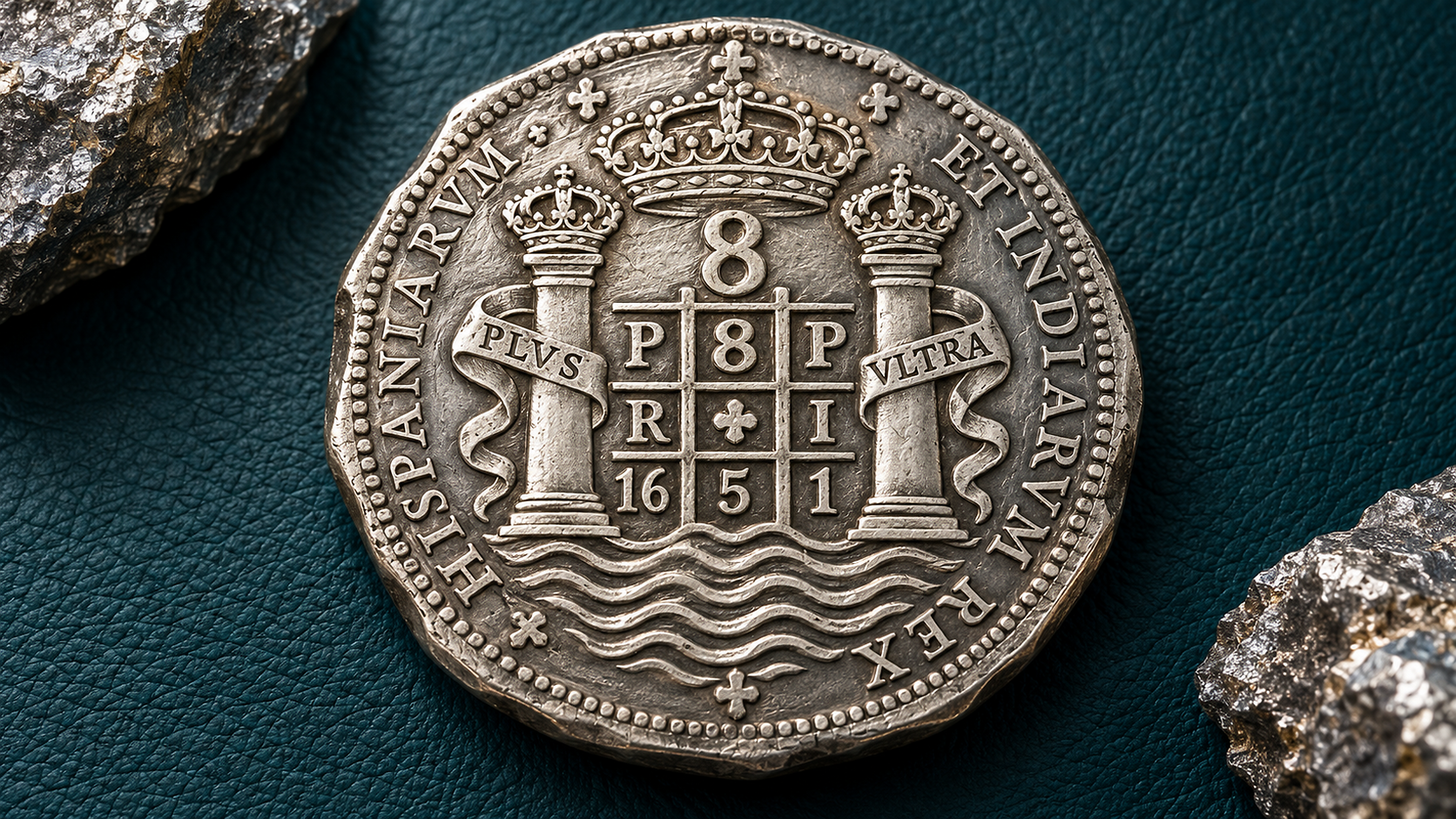
To convince the world that Potosí silver was once again trustworthy, the Spanish Crown completely overhauled the visual design of the coins. In 1651, royal decree outlawed the old shield design and introduced a bold, unmistakable new format that survived for a century.
The new design featured the twin Pillars of Hercules rising out of stylized ocean waves, symbolizing Spain's sovereignty over the territories beyond the Atlantic Ocean. Across the center ran the Latin motto Plus Ultra, meaning 'further beyond.' Between the pillars and across three horizontal registers, the mint stamped a strict grid of information: the mintmark, the denomination, the assayer's initial, and the date.
The brilliance of this layout was redundancy. The date appeared in three separate locations on the coin: once in the outer circular legend and twice inside the central grid. Even if an unscrupulous trader clipped the edges or if the hammer strike missed the rim, at least one complete date and assayer mark remained visible. This clear, verifiable design gradually restored international trust in Potosí silver.
Building an industrial powerhouse
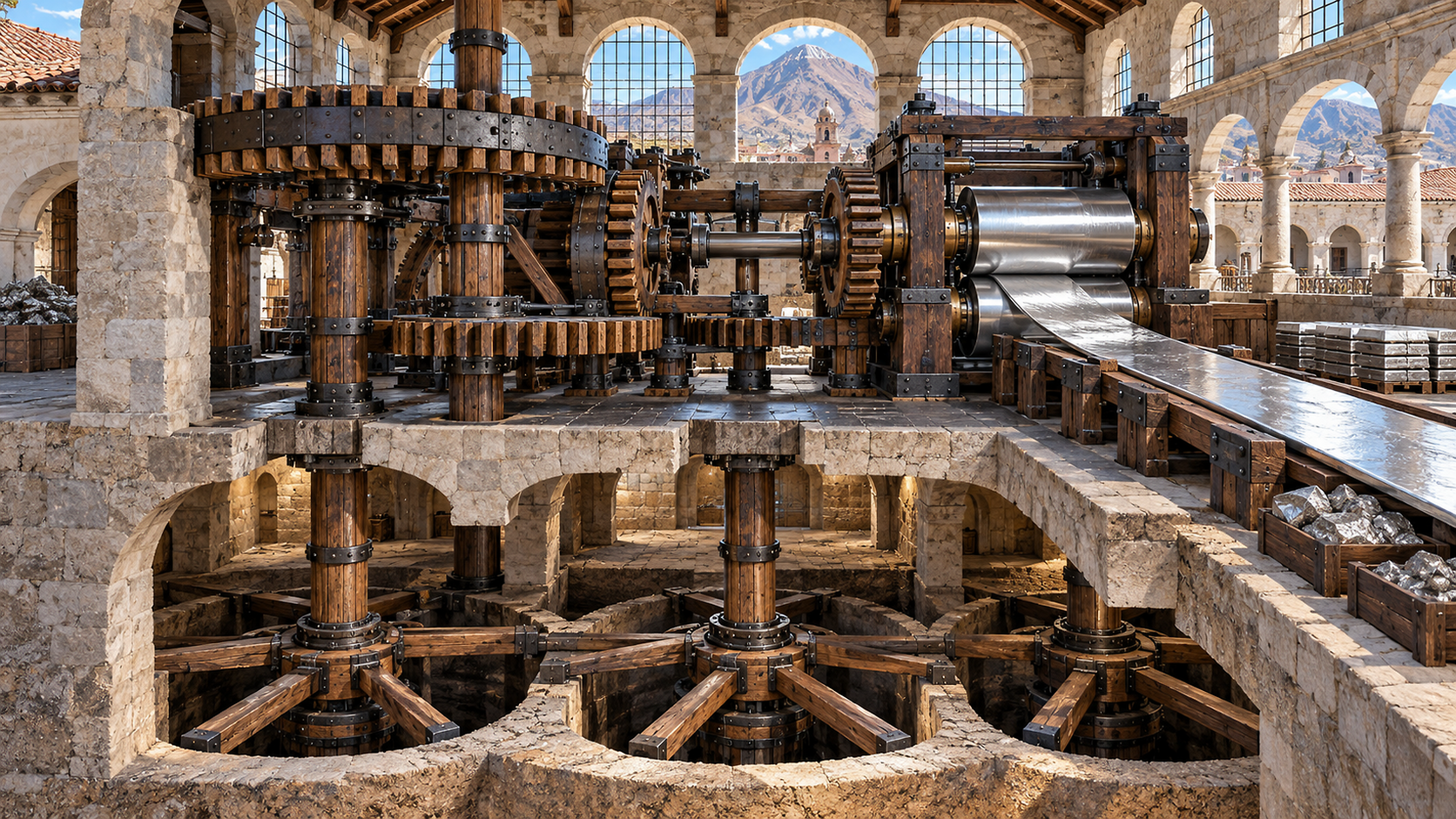
By the mid-eighteenth century, Spain's Bourbon kings were determined to modernize the empire's institutions. The old, chaotic, hand-hammered method was no longer acceptable. European trade demanded smooth, uniform, perfectly round coins that could not be shaved or clipped by fraudsters. To achieve this, Potosí needed an entirely new industrial complex.
Between 1759 and 1773, the Crown constructed a colossal new Casa de la Moneda that covered an entire city block. Built of heavy mountain stone, hand-hewn cedar beams, and sun-dried adobe bricks, it was one of the largest civil buildings in the Americas. Inside were foundries, assay laboratories, rolling mills, vault rooms, and barracks for armed guards.
The centerpiece of the new mint was its machinery, imported across oceans and mountains. Heavy wooden rolling mills, powered by teams of mules circling capstans on the floor below, squeezed silver ingots into sheets of uniform thickness. For the first time, human muscle and hand hammers were replaced by mechanical force, transforming the mint from a noisy artisan workshop into an industrial coin factory.
The age of the screw press
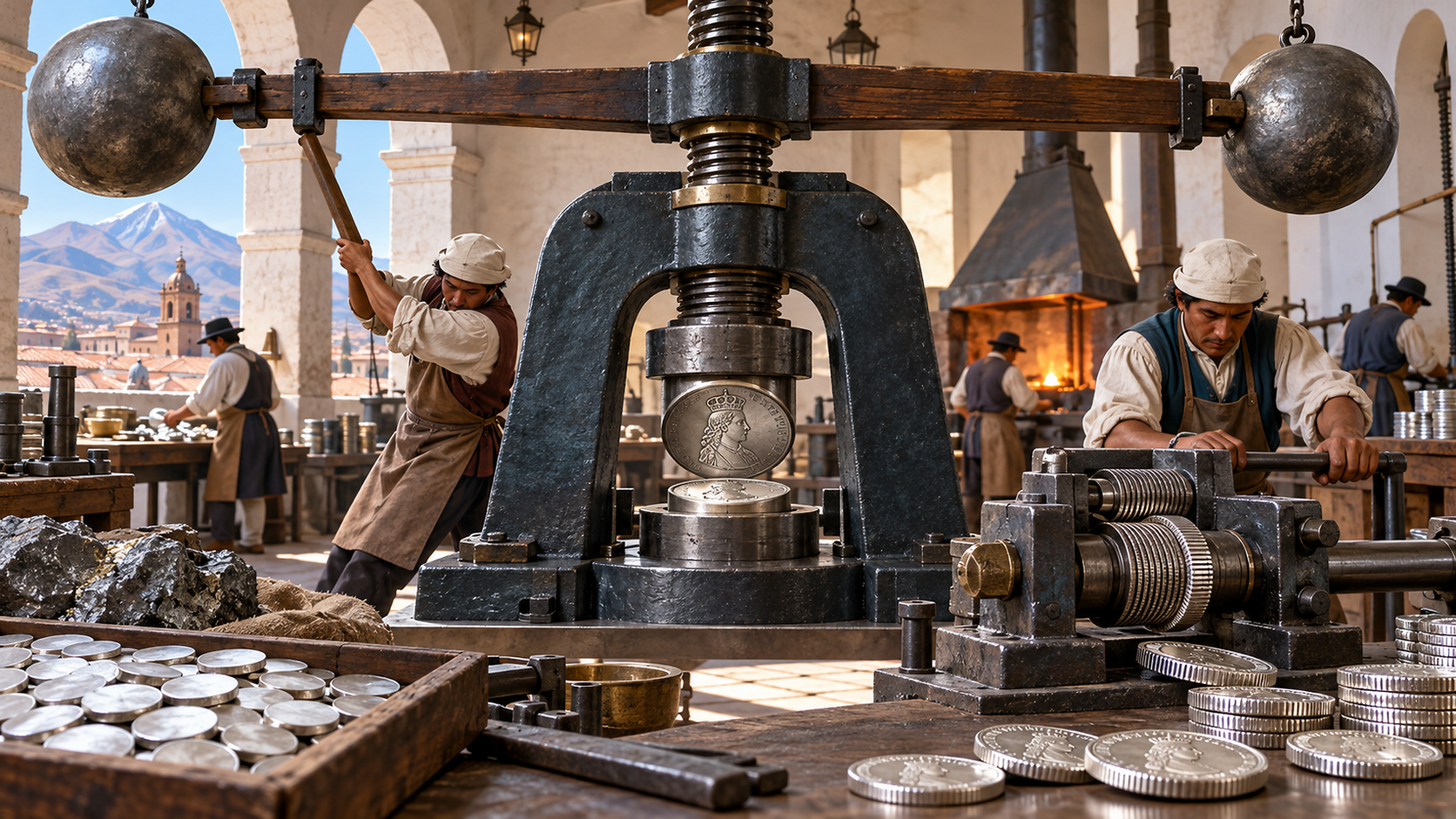
The introduction of the fly press, or screw press, revolutionized coin striking in Potosí. Unlike a hammer blow, which landed unevenly, a screw press used a heavy iron screw threaded through a solid frame. A counterweighted lever arm swung overhead, driving the screw downward with immense, uniform pressure.
Before entering the press, circular blanks were cut using mechanical punch dies and run through an edging machine. This machine stamped a raised pattern of leaves or cords along the coin's outer rim. This milled edge was a critical security breakthrough: if anyone scraped or filed metal off the edge of the finished coin, the patterned border was destroyed, alerting merchants immediately that the coin had been altered.
In 1773, the new mint began regular production with the portrait series, displaying the bust of the reigning Spanish monarch on the obverse. These new coins were flawlessly round, beautifully detailed, and strictly uniform in diameter and weight. Potosí had moved from the hand-hammered craft of cob striking into modern mass production.
How Potosí coins circled the planet
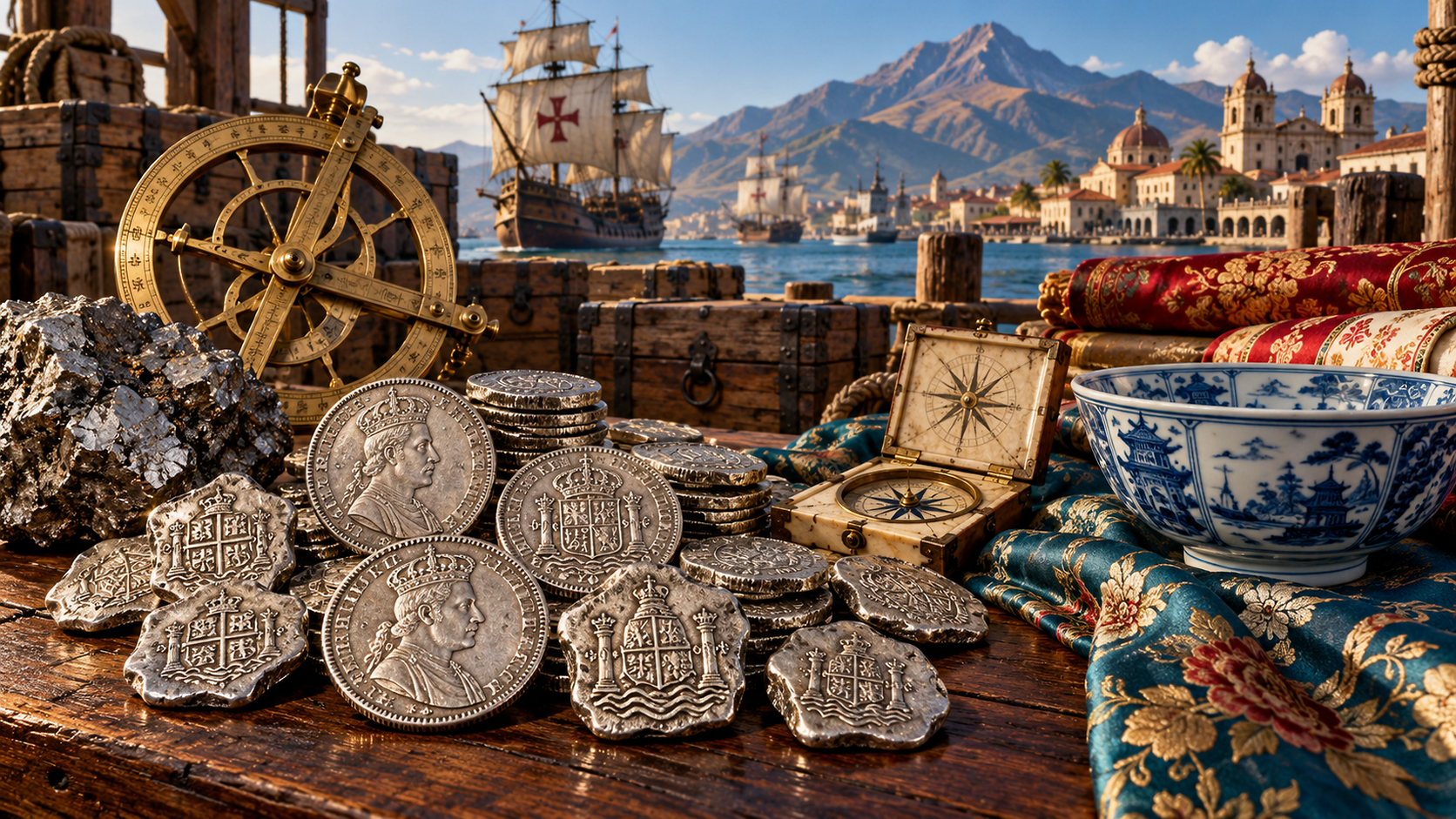
Silver coins struck high in the Bolivian Andes did not stay in South America. They moved along trade routes that formed the first truly global currency system. Mules carried heavy wooden chests of silver down mountain tracks to the Pacific port of Callao, near Lima. From there, armed ships carried the treasure north to Panama, where it crossed the isthmus on pack animals before loading onto Atlantic treasure galleons bound for Seville and Cádiz.
Another major stream of Potosí silver sailed west. From Callao and Acapulco, the famous Manila Galleons carried millions of silver pesos directly across the Pacific Ocean to the Philippines. In the markets of Manila, Spanish merchants traded Andean silver for Chinese silk, porcelain, spices, and tea. The Ming and Qing empires ran on a silver economy and had a voracious appetite for New World bullion, absorbing a huge share of all the silver Potosí ever mined.
In North America, Potosí pieces of eight circulated widely because British colonial authorities prohibited the export of official English coins. People called them 'Spanish milled dollars.' When the young United States established its own currency system in 1792, it modeled the size, weight, and silver content of the US dollar directly on the eight-real coin. In fact, Spanish colonial silver coins remained legal tender in the United States until Congress passed the Coinage Act of 1857.
Inside the mountain mint today
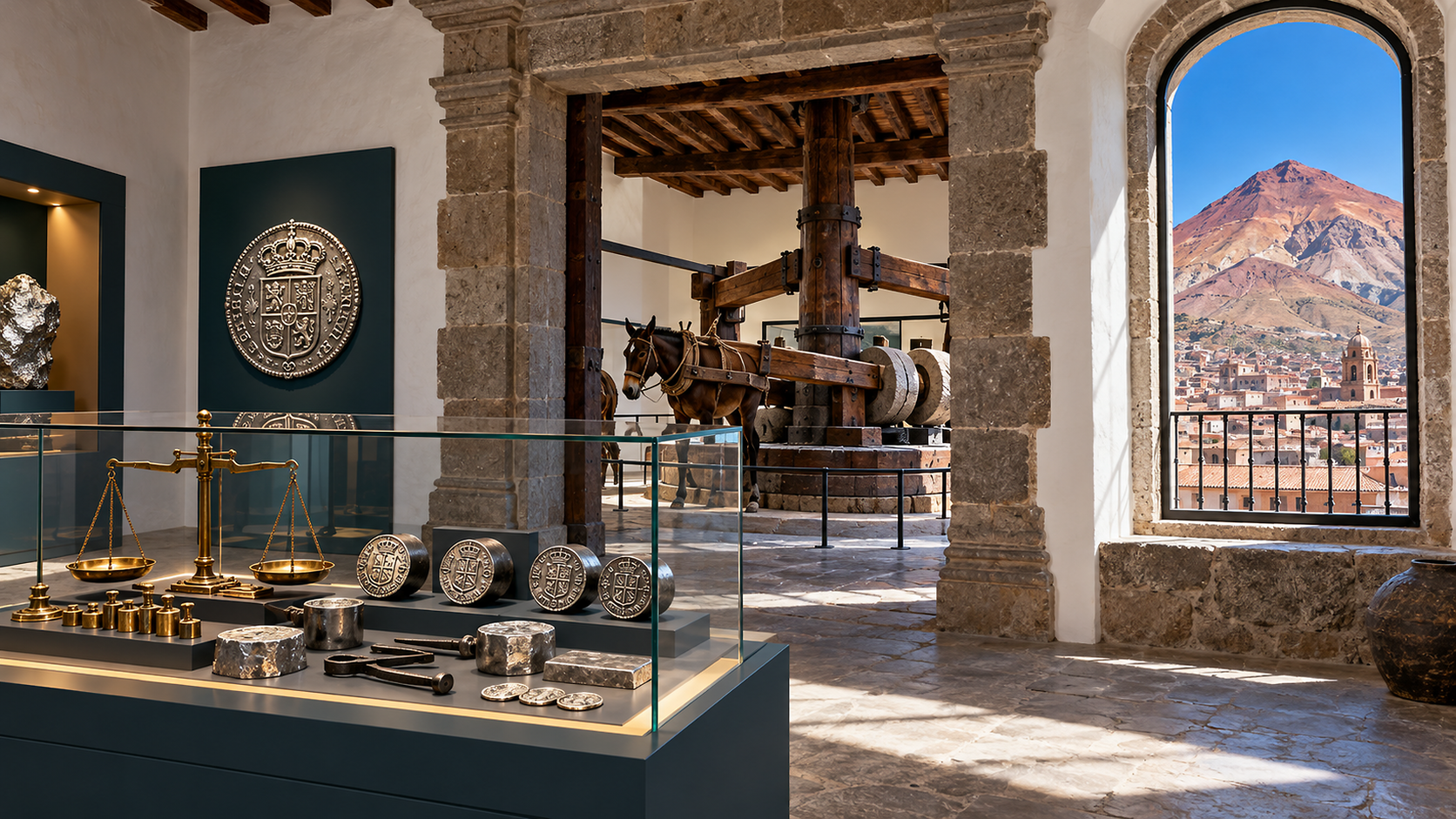
Spanish rule in Potosí came to an end in 1825 when revolutionary forces established the Republic of Bolivia. The mint continued to strike coins for the new nation, producing silver and gold currency with republican emblems through the nineteenth century until steam presses replaced the historic wooden mills, and finally closed its minting operations in the twentieth century.
Today, the second Casa de la Moneda stands as a world-renowned museum and a UNESCO World Heritage Site. Remarkably, much of its original eighteenth-century equipment survives intact. Visitors can walk through cold stone rooms to see the massive wooden gear assemblies, built from Andean cedar, that transferred power from mule teams on the ground floor to the rolling mills above.
Cerro Rico still looms over the city skyline, scarred by centuries of tunneling and open pits. While the mountain's richest silver veins have long been emptied, miners still enter its tunnels daily looking for tin, zinc, and trace silver. Below the peak, the stone walls of the mint remain from an era when a remote mountain city struck the money that kept the world moving.
Further reading
Explore the subject further with these references.
Casa Nacional de la Moneda, PotosíExternal reference · Opens in a new tab American Numismatic Society: Spanish Colonial CoinageExternal reference · Opens in a new tab The Potosí Mita, 1573–1700 (Stanford University Press)External reference · Opens in a new tab